Quick answer
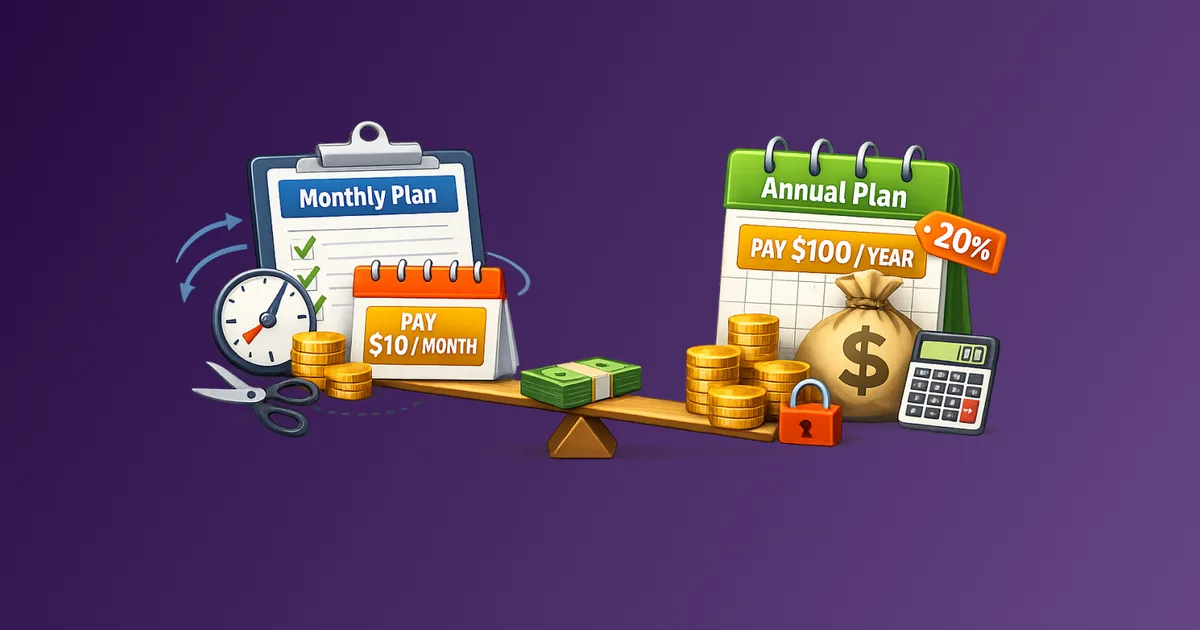
divide the annual plan cost by the monthly plan price. The result is the number of months you need to use the service before the annual plan becomes cheaper. If you are confident you will use it longer than that, pay annually. If there is any real chance you will cancel before that threshold, monthly billing protects you.
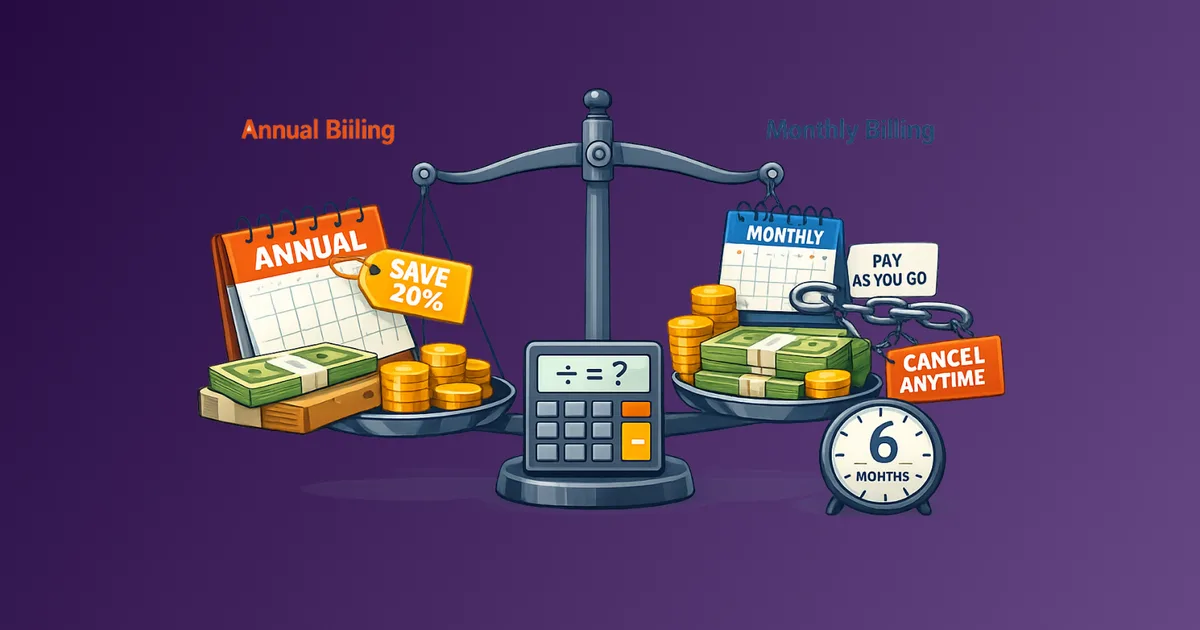
Annual billing looks like a clear win on paper. Pay upfront, save 20%, done. But the math only holds if you keep using the service for the full year. If you cancel early, the discount turns into a loss. This article gives you a straightforward break-even method to make that decision in under five minutes.
Stay Updated with Subtrakr
Sign up to our newsletter to get updates about Subtrakr and valuable insights about subscriptions and recurring expense management.
What Inputs Do You Actually Need to Make This Decision?
Three numbers. That is it.
- The monthly plan price
- The annual plan price (total, not the "per month" marketing figure)
- Your honest estimate of how long you will keep using the service
Everything else is noise. The discount percentage matters only as context. The real question is whether your expected usage exceeds the break-even threshold.
Example: a project management tool costs $18/month or $144/year (advertised as $12/month).
- Break-even = $144 / $18 = 8 months
If you use it for 8 months or more, annual saves you money. If you stop at month 6, you effectively paid $24/month - 33% more than the monthly rate.
How Do You Run the Break-Even Calculation in 5 Minutes?
This is the full worksheet. You can do it mentally or in a notes app.
Step 1: Get the actual numbers
Find the monthly price and the annual total. Ignore "equivalent monthly" pricing shown on annual plans. That number is designed to make annual look attractive. You need the real total you will be charged.
Step 2: Calculate the break-even point
Break-even (months) = Annual total / Monthly price
Step 3: Estimate your confidence score
Ask yourself: "How confident am I that I will still be using this in break-even month?"
Score it simply:
- High confidence (90%+): Pay annually
- Medium confidence (60-90%): Check the gap between break-even and your expected end date
- Low confidence (below 60%): Stay monthly
Step 4: Factor in cancellation friction
Some services make cancellation easy. Others bury it. If cancellation is difficult and your confidence is medium, lean monthly. The hidden cost of inertia is real.
Step 5: Check refund policy
A few services offer prorated refunds on annual plans. If they do, annual becomes much lower risk. Verify before committing.
Worked examples
| Service | Monthly | Annual total | Break-even | Decision |
|---|---|---|---|---|
| Streaming app | $15 | $120 | 8 months | Annual if confident through month 8 |
| Design tool | $25 | $240 | 9.6 months | Annual only if you rely on it heavily |
| Password manager | $4 | $36 | 9 months | Annual - low risk, high stickiness |
| Project tool (freelancer) | $18 | $144 | 8 months | Depends on project pipeline length |
What Behavioral Traps Make This Decision Harder Than It Needs To Be?
Two traps consistently skew this decision in the wrong direction.
Trap 1: Inertia bias
When you pay annually, you tend to keep the subscription even when you stop using it regularly. Not because you need it, but because you already paid. This is the sunk cost pattern applied to subscriptions. The correct framing is: the money is already spent. The decision now is whether the remaining months justify staying. But most people do not reframe it that way. They keep paying on auto-renewal the following year as well.
As covered in How Recurring Payments Rewired the Human Brain, annual commitments create psychological lock-in that works against consumers. The service provider benefits from your reluctance to "waste" a paid year.
Trap 2: "I paid so I must use it" pressure
Annual billing creates a false obligation to justify the purchase. You might use a tool more than you need to, simply because you paid for a full year. This does not save you money. It costs you time. Usage frequency is not a return on investment - it is just behavior shaped by guilt.
Both traps favor the vendor. Understanding them does not make you immune, but it does make the break-even math more honest. You are not just calculating whether you will use the service. You are calculating whether you will use it without distortion from the commitment you made.
When Is Monthly Billing the Strategically Better Choice?
Monthly billing is not just a fallback for indecisive users. In several situations, it is the correct financial decision.
- When your usage is project-based. Freelancers and contractors often need tools for a specific engagement and nothing after. Paying monthly and canceling cleanly is cheaper than paying annually and forgetting to cancel. This is a recurring theme in How to Optimize Recurring Expenses for Freelancers and Small Businesses.
- When you are evaluating a new category. If you have never used a tool in a given category before, your churn probability in the first 90 days is higher than you think. Stay monthly until the habit forms.
- When the service is still early-stage or unstable. Annual commitments to products that might raise prices, change features, or shut down carry real risk. Monthly plans give you an exit without loss.
- When the discount is below 15%. Smaller discounts compress the savings and make the break-even point later in the year. At a 10% annual discount, you need to use the service for almost 11 months just to break even.
- When you have a high active subscription count. If you are managing 10+ recurring expenses, annual commitments create cash-flow concentration risk. A cluster of annual renewals in the same month is a budgeting problem, not just a tracking one. How to Stay on Top of Your Subscriptions addresses this directly.
Is There a Simple Rule of Thumb for This Decision?
Yes. Use this as a starting filter:
Pay annually if:
- The discount is 20% or more
- Your break-even point is 8 months or fewer
- Your confidence in continued use is above 80%
- The service is a daily or near-daily habit
Stay monthly if:
- Your confidence drops below 70%
- The break-even point is beyond month 9
- The service is project-based or experimental
- You are already carrying several annual plans and want cash-flow flexibility
This is not a perfect model. It is a fast filter that eliminates obvious mistakes on both sides. For decisions that land in the middle, the worksheet above gives you structure to go deeper.
Common Mistakes
Using the advertised monthly equivalent
Annual plans are always marketed with a per-month figure that makes the discount look clean. That number is not what you are charged. Always use the actual annual total for break-even math.
Ignoring auto-renewal timing
If you forget to cancel before the annual renewal date, you are committed for another full year. Build a cancellation reminder at the 10-month mark for every annual plan you hold. A subscription renewal calendar helps eliminate this risk.
Conflating price with value
A cheaper plan is only better if you use it enough for the savings to materialize. Value is not the same as cost.
Not checking refund policy upfront
Some providers offer partial refunds if you cancel an annual plan mid-year. If they do, the downside risk of going annual shrinks significantly. This takes 60 seconds to verify and most people skip it.
FAQ
What is the break-even point for annual billing?
It is the number of months you need to use a service before the annual plan becomes cheaper than paying monthly. Calculate it by dividing the annual total by the monthly price.
Is annual billing always worth it?
No. Annual billing is worth it only if you use the service past the break-even point. If you cancel early, you end up paying more per month than the monthly plan would have cost.
How do I decide between annual and monthly billing quickly?
Calculate the break-even month, estimate your cancellation probability, and check the refund policy. If your confidence in staying past break-even is high, pay annually. If not, stay monthly.
What discount makes annual billing worth it?
Generally 20% or more. Below 15%, the break-even point extends so late in the year that the margin of safety shrinks significantly.
Should freelancers pay annually for tools?
Only for tools used consistently across projects. For project-specific tools, monthly billing is usually more cost-effective because it allows clean cancellation without loss.
What happens if I cancel an annual plan early?
In most cases you forfeit the remaining balance. Some services offer prorated refunds. Always check the refund policy before committing to an annual plan.
Run the Numbers Before You Commit
The next time you see an annual billing option, do not click through on instinct. Take five minutes. Pull up the two prices, calculate the break-even month, and give yourself an honest confidence score. That is the whole method.
Before you run those numbers, set the pre-commit rules in Annual Commitments Without Regret: Guardrails to Set First. Prove-it period, exit terms, renewal control, and an annual plan cap keep the discount from turning into lock-in regret.
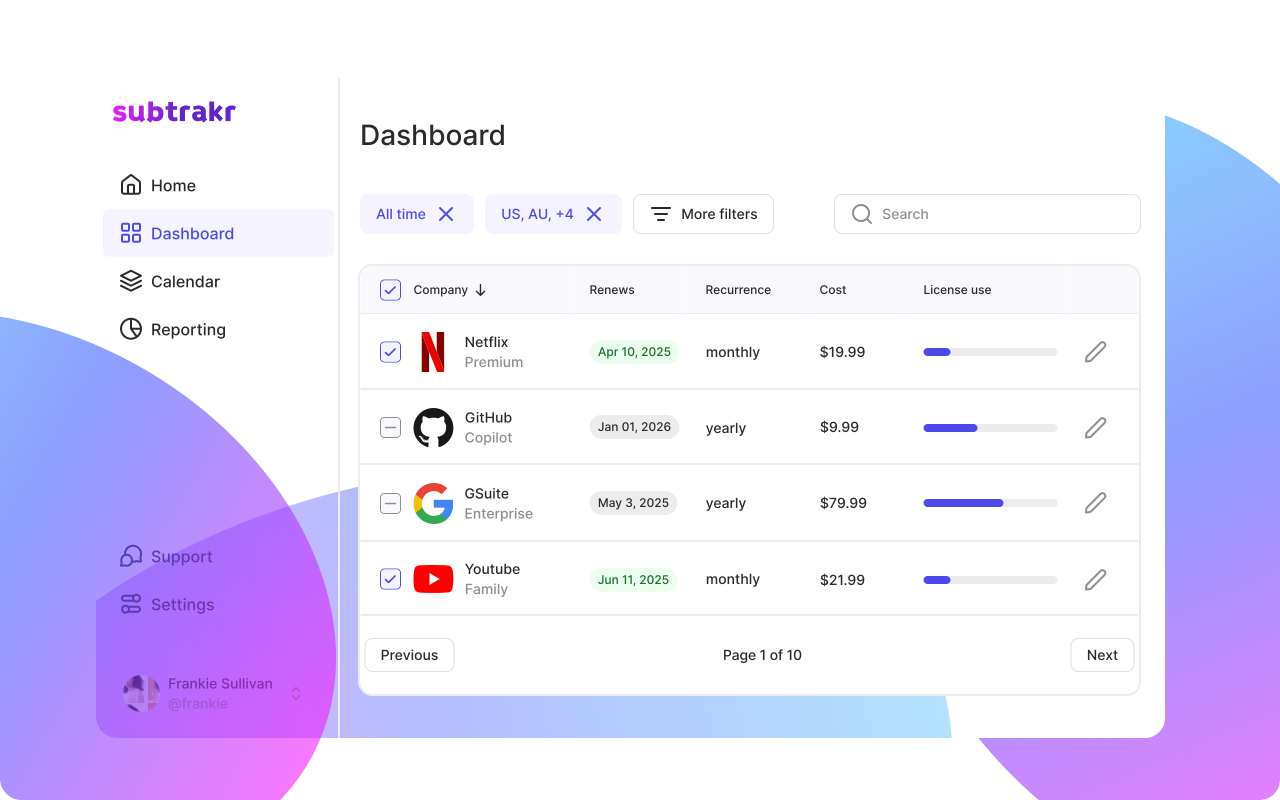
If you want a structured place to log all your subscriptions alongside billing cycles and renewal dates, Subtrakr was built for exactly that. Manual input creates the kind of intentional awareness that automatic scrapers skip.