Quick answer
In the era of subscription services, a $5 or $10 monthly charge hardly catches our attention. These recurring payments quietly accumulate until they add up to rent money. The shift from one-time purchases to recurring subscriptions has essentially rewired how our brains perceive value, ownership, and spending in the digital age. This article explores the behavioral science and neuroscience behind phenomena like the "pain of paying," why automated payments reduce friction and accountability, and what it all means for our financial habits.
Introduction
In the era of subscription services, a $5 or $10 monthly charge hardly catches our attention. These recurring payments – from Netflix and Spotify to meal kits and cloud storage – quietly accumulate until "together, they add up to rent money". Consider the story of one college student who scrolled through her phone and discovered a design app charging her $20 a month that had "slipped under [her] radar". She hadn't used the service in weeks and "thought [she] didn't have to pay for it", highlighting how easy it is to lose track of automated charges. Her case reflects a broader trend: in a 2022 survey, consumers estimated they spent about $86 per month on subscriptions, but their actual spending averaged $219. This huge gap reveals how our perception of spending is distorted in the subscription economy. The shift from one-time purchases to recurring subscriptions has essentially rewired how our brains perceive value, ownership, and spending in the digital age. Below, we explore the behavioral science and neuroscience behind phenomena like the "pain of paying," why automated payments reduce friction and accountability, and what it all means for our financial habits.
Stay Updated with Subtrakr
Sign up to our newsletter to get updates about Subtrakr and valuable insights about subscriptions and recurring expense management.
The Rise of Recurring Payments and Subscription Psychology
Not long ago, ownership was the norm – we bought music on CDs, paid upfront for software, and owned DVDs or books. Today, we increasingly pay for access over ownership. For the price of a monthly subscription, we can unlock vast libraries of songs or movies far beyond what we could ever own, with Spotify's 70+ million song catalog providing far more utility than a personal vinyl collection. This "economy of access" has tremendous convenience, but it also plays into our psychological quirks. Companies intentionally design subscription models to leverage consumer biases. We sign up in seconds for a "free trial" or low monthly fee, enjoying instant gratification, but canceling can be complex and delayed – often by design. The result is that we often stay subscribed even to services we use sparingly, because the psychological forces at work encourage inertia.
One key factor is that a small recurring fee feels much more palatable than a large one-time expense. As one behavioral economist observes, "parting with a large sum seems to hurt more than having the payment deferred and chunked into many seemingly more painless payments… every month." In other words, spreading a cost into monthly increments "tricks" our mind by reducing the perceived pain of each payment. A professor notes that subscriptions "are set up as a low upfront cost," and people struggle to recognize what that means over a year or longer. We don't readily multiply $9.99 by 12 in our heads; $9.99 feels closer to $9 than $10, an example of the anchoring effect in pricing (where $9.99 seems cheaper than $10 even though it's essentially the same). In a sense, our brains focus on the now – "five dollars here, ten there" – and largely ignore the accumulating total.
The result is a new kind of consumer behavior: we accumulate dozens of low-cost subscriptions and forget their true cost. Many people are willing to "pay recurrently for a service, even if it's not utilized fully," treating it like a membership that they might only sporadically use. We justify it by the access it provides and the comfort of knowing it's there when we want it. In the process, how we evaluate value and spending has fundamentally changed.
Small monthly fees for subscription services often feel trivial on their own. It's only when we step back that we see the larger pattern of spending that these recurring payments create. Our brains are quick to accept a $9.99 monthly charge as minor, even as such fees collectively accumulate into significant expenses.
The "Pain of Paying" – and How Subscriptions Numb It
Why do we tend to spend more with subscriptions and automated payments? Neuroscience offers an answer in the concept of the "pain of paying." When we spend money, especially in a tangible way, we actually activate regions of the brain associated with pain and discomfort. Brain scan studies have shown that making a purchase can trigger the anterior insula – the same area that processes physical pain. In these experiments, "prices perceived to be excessive" light up the brain's pain centers and can even deter a purchase. Handing over a stack of cash, for example, creates a visceral sense of loss, whereas swiping a credit card or tapping a phone spreads out or delays that sensation. Psychologists note this is tied to loss aversion – we feel the loss of money more strongly than the pleasure of what we purchased. In effect, paying is psychologically painful, and this pain is a natural barrier that makes us think twice about spending.
Crucially, modern payment methods are engineered to minimize this pain response. The more frictionless a payment is, the less we "feel" the act of spending. Counting out paper bills or physically seeing money leave your hand creates a high degree of pain and reinforces self-control, acting as a "natural brake on spending." In contrast, when you swipe a card or use a one-click payment, the pain is deferred or diluted, and you tend to spend more freely. As one neuroscience and marketing expert put it, "newer payment methods are specifically designed to reduce that pain, making it easier than ever to part with your money."
Recurring digital payments take this pain reduction to the extreme. Automated subscriptions decouple the act of paying from the act of consumption. When a service charges you every month behind the scenes, you don't physically experience the transaction at all – often you don't even notice it. "Mobile payments, one-click ordering, and subscriptions reduce this pain to near-zero, removing the brain's natural 'brakes' on spending," observes one analysis. In fact, subscription services like Netflix or Amazon Prime "eliminate the pain of individual transactions" by converting purchases into a predictable monthly fee. You never get that moment of pang – you don't feel like you're buying each show or song; "you just have access." One illustrative example is all-inclusive resorts or streaming platforms: you pay upfront or subscribe, and thereafter each use feels "free" – the painful payment happened earlier (or automatically), so everything after feels like a bonus.
Over time, our brains can even adapt to these low-pain payments. A Dutch study in 2024 found that contactless card payments caused the least "pain of paying" of any method, and people who frequently used contactless experienced even less discomfort – essentially training themselves to seek out the path of least resistance in spending. In the case of subscriptions, this adaptation is even more pronounced: there is often no conscious payment event at all to trigger discomfort. One industry piece bluntly notes that with subscriptions, the pain level is "none" – the purchase feels like "access" not "buying," encouraging a "set it and forget it" mindset that leads to recurring costs happening without deliberate review. In psychological terms, separating the payment from the moment of use makes the cost emotionally invisible, allowing spending to slip by unchecked. As a marketing professor explains, "if subscriptions were paid in cash, it would feel very different" – but with automatic digital payments, "when payment is separated from the moment of use, that pain fades. Spending becomes easier, and subscriptions slip into the background."
Why We Keep Paying: Behavioral Biases on Autopilot
If eliminating the pain of paying explains why we spend more readily with subscriptions, other behavioral biases explain why we stay subscribed – even to services we're not using fully. Companies behind recurring services are well aware of these cognitive biases and design their offerings to take advantage of them. Here are some of the key psychological phenomena that lock us into subscriptions:
Loss Aversion: Humans strongly prefer avoiding losses to achieving equivalent gains. Once we have a service as part of our life, canceling it feels like a loss – even if canceling would save money. As Professor Frank Jee describes, "canceling feels like giving up something that already belongs to you". We don't want to lose our curated Spotify playlists or our personalized recommendations. One overview noted that subscriptions exploit this bias: once a service is integrated into our routine, "cancellation feels like losing access rather than saving money." The pain of missing out on benefits looms larger than the pain of monthly charges, so we keep paying to avoid feeling a loss.
Sunk-Cost Fallacy: The longer we've been paying for a subscription, the harder it is to let it go. After several months of fees, people often continue subscribing to justify the past expense, a classic sunk-cost effect. We think, "I've already invested so much into this service; if I cancel now, all that money was wasted." This mentality can turn short-term trials into years-long payments. Meanwhile, we might also overestimate how much we'll use the service going forward because we want to believe those past payments were worthwhile. For a concrete method to counter this in annual-plan decisions, see Annual vs Monthly Billing Break-Even: Decide in 5 Minutes.
Habit and Inertia: Recurring payments are, by definition, automatic – which breeds habit. It "becomes part of a routine" over time. Psychologically, the absence of decision points (since the default is to keep paying) means status quo bias kicks in: we simply continue what we've been doing. The path of least resistance is to do nothing, so inertia keeps the subscription going. Additionally, as noted earlier, not having to make a decision each month reduces cognitive load. Research shows that eliminating small, repeated decisions can preserve mental resources – subscribing spares us from having to decide "Do I buy this again?" every time. This reduced decision fatigue feels convenient, but it also means we rarely pause to reconsider whether the service is still worth it.
Price Anchoring and Trivialization: The way subscription prices are framed takes advantage of our tendency to anchor on the initial number we see. A service marketed at "only $9.99 a month" plants an anchor in our mind that it's about ten bucks, which feels trivial for the value promised. We often ignore taxes, fees, or the aggregate cost over a year. Reading $9.99, our brain says "nine dollars-ish" – a classic anchoring effect – even though in reality that is essentially $120 a year for something we might have hesitated to buy in one lump sum. Moreover, the frequent use of charm prices ($9.99, $14.95, etc.) makes the fee appear smaller and more palatable. By presenting costs in monthly terms, companies make expenses feel micro: "just a few dollars a week" – exploiting our tendency to downplay small, frequent losses.
Social Norms and FOMO: Our subscription decisions don't happen in a vacuum – they're often influenced by peers and cultural norms. When all your friends use a certain streaming service or everyone at work has a premium productivity app, opting out can feel like being left out. This social pressure nudges us to subscribe because it's what everyone else is doing (herd behavior). Companies amplify this by invoking FOMO (Fear of Missing Out): the idea that if you don't subscribe, you'll miss exclusive content, the latest trends, or a limited-time rate. There's also FOBO (Fear of Better Options) – anxiety that if you cancel, you might lose a grandfathered price or be unable to get the same deal later. All these factors create a psychological urgency to keep subscriptions active, lest we regret losing out.
These biases work together to make canceling a subscription psychologically difficult. Small wonder that companies often couple them with deliberate obstacles to cancellation (long processes, fine print, etc.). It's a potent combination: our own minds provide enough resistance to canceling that services can profit for months before we take action. As a result, people often stay subscribed to things that no longer provide equivalent value, paying largely on autopilot.
From Ownership to Access: Changing Our Sense of Value and Ownership
The subscription model doesn't just affect how we pay; it's also changing our notion of what it means to "own" something and how we derive value from products and services. In the traditional one-time purchase model, paying a large amount upfront grants a clear sense of ownership – you bought a car, a DVD, or a piece of software, and it's yours. With recurring services, you rarely own anything tangible; instead, you're paying for continuous access or ongoing updates. This shift has psychological consequences:
Dematerialization of Value: Many of the things we now pay for are intangible or cloud-based. For example, millions of listeners no longer own music albums at all, yet they have access to virtually every song through streaming subscriptions. As one analysis noted, "Spotify's 70+ million songs occupy no physical space but provide greater utility than a personal vinyl collection," and studies show younger generations even derive more of their identity from accessed digital content than from owned objects. In a way, access itself has become a product we value. We measure value in terms of variety, convenience, and immediacy rather than physical possession. This dematerialization means the satisfaction of ownership (pride of having a book on your shelf, for instance) is replaced by the satisfaction of availability (knowing any book is a click away on your e-reader).
The Endowment Effect – Without Owning: Normally, owning something makes us value it more (the endowment effect), because it feels like ours. Subscription services have found ways to trigger a pseudo-endowment effect without actual ownership. Personalized profiles, saved favorites, watchlists, and playlists all create a sense that the service is tailored to you. Your Netflix or Spotify account starts to feel like "your" collection of shows and songs, even though you don't own the content. This increases attachment: as one expert put it, personalization "creates a sense that content or services are uniquely tailored to us, increasing perceived ownership despite the absence of legal possession." In other words, even if we know intellectually that we don't own the movies or music, it feels like ours because it's our curated experience – making us even less likely to give it up.
Reduced Ownership Burden: Interestingly, the lack of ownership can also relieve certain anxieties. Owning things comes with responsibilities – maintenance, updates, storage, the risk of obsolescence. Subscription models transfer that responsibility to the provider (e.g. software subscriptions ensure you always have the latest version without managing upgrades, car subscription services handle maintenance). Psychologically, this can reduce what researchers call "maintenance anxiety". We enjoy the benefits without the full mental load of caring for an item long-term. This makes the subscription feel convenient and light – you enjoy it when needed and need not worry about it otherwise. Consumers increasingly appreciate this trade-off: for example, many are happy to lease or subscribe to a car rather than own it, to avoid the hassle of repairs and resale. The flip side, however, is that we surrender a degree of control. If the provider changes terms or goes out of business, or if we simply stop paying, we lose access entirely. The security of ownership (knowing something is yours no matter what) is replaced by the contingency of access (you have it as long as you keep paying).
Shifting Notions of Value: With subscriptions, value is often framed as ongoing service rather than a one-time exchange. This leads to an expectation of continuous improvement or new content to maintain our interest (since we're effectively re-evaluating the value every billing cycle, even if subconsciously). Companies must "continuously earn loyalty rather than securing one-time transactions", as subscription business analysts note. From the consumer perspective, we start to see value in terms of engagement over time. For instance, instead of asking "Is this software worth $300 to buy?" we ask "Is it worth $20 a month, given how often I use it?" Sometimes this makes us more critical – if we stop finding fresh value, we may consider canceling. Other times it makes us more forgiving – we might accept that we don't use a service every day, as long as it occasionally provides a high-value experience (much like a member of a club who doesn't visit every week but maintains membership for the few times they do go). In either case, how we judge worth has become a more fluid, ongoing calculation rather than a one-time decision.
In summary, the migration from ownership to access has altered our psychology: we place less importance on possessing things and more on the experience and convenience of being able to use them whenever we want. Our brains, especially younger consumers', are adapting to a world where subscription access is the default. It offers incredible flexibility and personalization – but it also means we must be careful, because this model is finely tuned to keep us paying without us noticing how our relationship to money and possessions is evolving.
Hedonic Adaptation: When Novelty Becomes Necessity
When a new subscription service enters our life, it often brings a surge of convenience or enjoyment – a little hit of happiness. But human brains are prone to hedonic adaptation, the tendency to quickly get used to improvements and revert to a baseline level of satisfaction. With recurring services, this means that yesterday's luxuries can rapidly become today's necessities.
For example, the first time you sign up for a meal-kit delivery or premium music streaming, it might feel like a significant upgrade to your life. Over time, however, the novelty fades as you adapt to this higher standard of convenience. What was once exciting is now routine – you barely notice it, except perhaps when it's taken away. Psychologically, we start taking the service for granted, folding it into our expectations. As one report on student spending noted, after using various subscriptions regularly (music on the way to class, streaming before bed, on-demand food delivery), "students begin to see optional services as necessities." This is hedonic adaptation in action: our baseline has shifted upward such that not having the service would feel like a loss or a downgrade. The convenience becomes normalized.
This adaptation has two major effects on our spending behavior:
We accumulate more subscriptions to chase new hits of satisfaction. Once one service becomes ordinary, we might add another to get that sense of something new again. Perhaps streaming music is no longer thrilling, so we subscribe to a podcast platform or a meditation app for fresh content. In the long run, this can lead to subscription overload – a bloated roster of services that each provided a short-term boost in happiness but collectively burden our budget. There's already talk of "subscription fatigue," as consumers juggle so many services that the complexity and cost start undermining the benefits. Our brains seek novelty and variety, and companies oblige with endless niche subscriptions – but we can only adapt upwards so much before it becomes unsustainable.
We become desensitized to the recurring payments themselves. Just as we adapt to the service, we adapt to the spending. The first few times you see the monthly charge for a new subscription, you might weigh it against your enjoyment. But after a while, the charge hits your account and you feel nothing – it's just part of life. In behavioral finance terms, we normalize the "money leaking out invisibly." One analysis described this as "the psychology of forgetting: the normalization of money leaking out invisibly, the habit of tolerating small losses, [and] the resignation that ten dollars 'doesn't matter.'" In other words, we train ourselves to tolerate these little monthly hits as if they're background noise. We might only realize how much we've adapted (and how much we're cumulatively spending) if we take a conscious look at our annual expenses or get a wake-up call like an expired card forcing us to re-evaluate subscriptions. By that point, however, each service may feel indispensable to us, making it emotionally challenging to cut back.
It's important to note that hedonic adaptation isn't inherently bad – it's a natural part of how we maintain equilibrium. But in the context of recurring payments, it means we must actively work to stay mindful. Our brains will not automatically alert us that we've stopped valuing a service as much as we used to, or that we're paying for things that no longer spark joy. Instead, we'll just keep paying unless we intervene. The subscription model bets on this: that once we've adapted to having the service, we'll keep it as a matter of course, even if the thrill is gone.
Navigating the Subscription Mindset: Regaining Control and Value
Recurring payments and subscription-based living aren't going away – they offer too much convenience and have reshaped entire industries. However, understanding the psychological tricks at play gives us a fighting chance to regain control over our spending and make sure our money aligns with what we truly value. If recurring payments have rewired our brains to be on autopilot, we can consciously reintroduce some manual control. Here are a few implications and strategies for consumers:
Bring Payments Back into Conscious View: Since the biggest danger with subscriptions is that they disappear into the background, simply making them visible again can counteract many biases. Regularly audit your subscriptions and recurring charges – list them out, see the annual cost, and ask yourself if each one is still worth it. Many people are surprised once they tally everything up, realizing they're paying hundreds for services they barely use. By restoring the "pain of paying" just a bit – for example, by manually reviewing bills or using apps that alert you to upcoming renewals – you re-engage the brain's natural budgeting instincts. Some consumers even choose to cancel and re-subscribe as needed (rather than maintaining continuous subscriptions) to force a moment of decision and appreciation whenever they pay for a service.
Use Digital Tools for Budgeting and Subscription Management: Ironically, the same technology that made spending frictionless can also help you make it visible again. Subscription charges tend to hide in plain sight because they are scattered across apps, card statements, and inbox receipts. A good subscription tracker or budgeting tool solves the core problem by pulling recurring payments into one clear view, so you are not relying on memory.
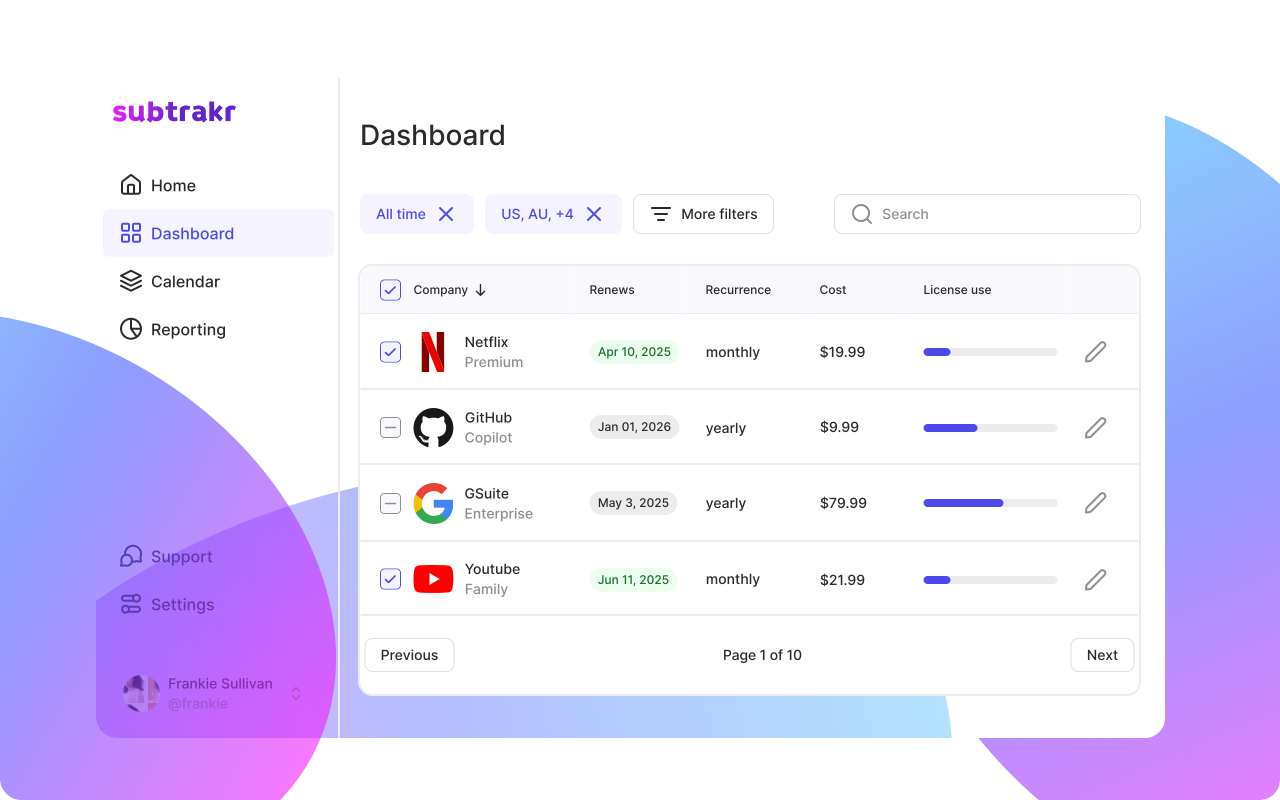
That is the point of tools like Subtrakr. Instead of trying to mentally juggle what is active, what is annual, and what quietly renewed last week, you can see your subscriptions in one place, spot duplicates, and catch the "I forgot I still pay for this" moments before they become a habit. It is not about shaming spending. It is about reducing uncertainty and restoring the accountability that automation removes.
A practical approach looks like this:
Centralize your recurring payments: Use one dashboard (banking tools, spreadsheets, or a dedicated subscription manager like Subtrakr) to list every subscription, the price, and the renewal date.
Add reminders where decisions matter: Set alerts for renewals, price hikes, or trials ending so you get a deliberate decision point back in your month.
Translate monthly fees into real numbers: Convert "just €9.99" into annual cost, and compare that to how often you actually use it.
Set a soft cap: Decide what you are comfortable spending on subscriptions each month. If you cross it, treat that as a prompt to review, not a failure.
The goal is simple: if recurring payments reduce the pain of paying, your tools should rebuild a little healthy friction by making spending legible again.
Leverage the Power of Pause and Choice: Behavioral research suggests inserting a pause or an extra step in the payment process can restore mindfulness (sometimes called a "cooling-off period"). While subscriptions remove pauses by auto-renewing, you can create your own. One idea is to turn off auto-renew on non-essential subscriptions and let them ask you to renew manually. That simple action forces a moment of choice: "Do I still want this?" If it turns out you do miss the service, you can always resubscribe – but you might find that you don't, and you just saved yourself money and attention. Some services now offer "pause" features where you can take a break for a month; using these can be a good test of whether a subscription has become a forgotten habit or truly valuable to you.
Set Rules Based on Value, Not Habit: Given the biases of loss aversion and sunk cost, it's helpful to establish some objective rules for yourself. For example, one finance professor advises ensuring that your subscriptions collectively don't exceed a small percentage of your budget (he suggests 5% of monthly income as a guideline for students). Another rule of thumb: for each subscription, periodically compare the cost to the actual usage or satisfaction you get. If you're paying $15/month for a video service but only watching one show on it, that's $180 a year for essentially one series – maybe not worth it. You could decide, for instance, that any subscription you haven't used in 30 days gets canceled, or that you won't have more than one service in the same category (music, video, gaming) at a time unless you truly use all of them. These rules guard against the slow creep of normalized spending.
Ultimately, the goal is not to reject recurring payments entirely, but to engage with them on our own terms. The subscription model has rewired our brains to be comfortable with small, automatic losses, to fear losing access, and to hand over control to companies' billing systems. To thrive in this environment, we must update our mental circuitry deliberately. That means staying informed about our spending, pushing ourselves to feel (at least a little) of that healthy pain of parting with money, and regularly aligning our spending with our actual needs and happiness.
Conclusion
Recurring payments have undoubtedly transformed the landscape of consumer behavior. They have redefined convenience and allowed us to fluidly access goods and services like never before. Yet, in doing so, they have also subtly altered how we perceive spending – reducing the sting of each purchase, but potentially to our detriment. As one neuromarketing expert warned, "for consumers, the easier it is to pay, the harder it is to control spending". The natural brake of cash is disappearing, replaced by frictionless transactions that our brains barely register. This is the double-edged sword of the subscription era: what feels effortless in the moment can lead to excess in the aggregate.
The good news is that understanding these psychological dynamics is the first step toward mastering them. We can enjoy the benefits of subscriptions and digital payments while implementing strategies to stay financially healthy. It comes down to awareness and intentionality – essentially, rewiring our brains back to be savvy in this new context. In a world where it's easy to sign up and harder to let go, remembering the true value of each dollar (or forgoing a bit of convenience now and then) can make all the difference. The question for each of us is not whether we can afford $4.99 for yet another subscription, but whether we can afford the mindset of forgetting – the creeping normalization of money "leaking out" with little to show for it. By staying mindful and proactive, we ensure that we, not our autopay algorithms, remain in charge of our spending and our happiness.