Quick answer
A renewal negotiation brief is a one-page prep sheet for an upcoming SaaS or subscription renewal. It captures contract terms, usage, alternatives, negotiation targets, and approval status so finance and ops align in minutes. Fill it once per renewal, share it before the notice deadline, and use it as the script for retention or account conversations.
Finance sees the invoice. Ops sees the workflow. Neither has a shared one-page summary when a SaaS renewal lands in the inbox three weeks before auto-renew. The result is rushed approvals, missed notice windows, and renewals that default to “same plan, same price.”
Stay Updated with Subtrakr
Sign up to our newsletter to get updates about Subtrakr and valuable insights about subscriptions and recurring expense management.
A renewal negotiation brief fixes that. It is a single document both teams can fill in before any vendor call, so the renewal becomes a decision with targets and evidence, not a calendar surprise.
What Is a Renewal Negotiation Brief?
A renewal negotiation brief is a standardized one-page summary of everything you need to decide and negotiate before a contract renews.
It is not a full business case. It is not a legal review. It is the minimum viable context: what you pay, what you use, what you could switch to, what you want from the vendor, and who approves the outcome.
Finance uses it to validate spend against budget and forecast. Ops uses it to confirm the tool still fits the workflow and to flag downgrade or migration risk. Together, they avoid the classic failure mode: finance optimizes for cost without usage context, or ops renews for convenience without price leverage.
If you already run renewal triage (renew, cut, or renegotiate), the brief is where that outcome turns into numbers and talking points.
When Should Finance and Ops Fill Out the Brief?
Start the brief when you enter the action window for that contract, not on the renewal date itself.
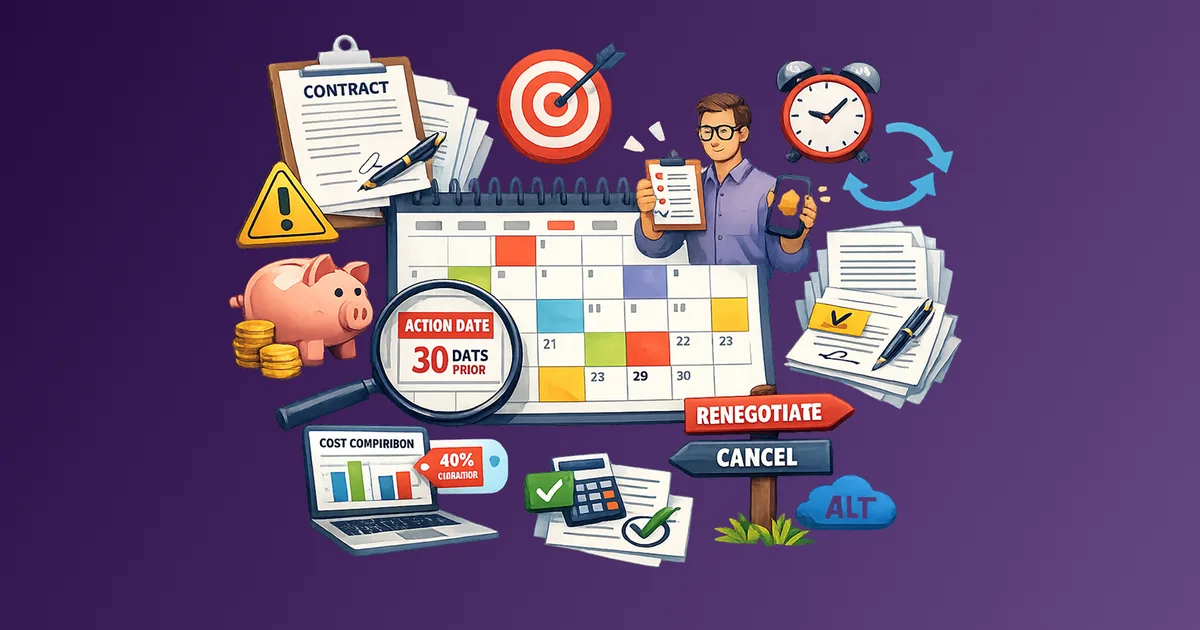
Your action window is: renewal date minus the vendor’s notice period minus a realistic prep buffer (usually 14 days). That logic comes from the same timing model as a SaaS renewal calendar.
Practical triggers:
- 90 days before renewal: Brief stub created (vendor, owner, dates, current ACV).
- 60 days before renewal: Usage and seat data pulled; triage outcome assigned.
- 30 days before renewal: Targets, alternatives, and ask list finalized; brief shared for approval.
- Before notice deadline: Negotiation owner contacts vendor with the brief as the internal reference.
Annual contracts and anything above a few hundred dollars per month deserve a full brief. Small monthly tools can use a stripped version (see FAQ).
What Should the One-Page Brief Include?
Every field should fit on one printed page or one screen. If it does not, you are mixing negotiation prep with a full vendor evaluation. Keep it scannable.
| Section | What it answers | Typical owner |
|---|---|---|
| Contract snapshot | What renews, when, and under what terms? | Finance / ops admin |
| Spend & budget | What we pay today vs plan? | Finance |
| Usage & value | Who uses it and for what outcome? | Ops / tool owner |
| Triage decision | Renew, cut, renegotiate, or downgrade? | Joint |
| Leverage & alternatives | What is our walk-away option? | Ops + finance |
| Negotiation targets | Ideal, acceptable, and walk-away price | Finance |
| Risks & dependencies | What breaks if we change plans? | Ops |
| Vendor ask list | Specific requests for the call | Negotiation owner |
| Approvals & timeline | Who signed off and by when? | Finance |
The brief does not replace license rightsizing or a procurement checklist for new tools. It is the renewal-specific layer: you already bought the product; now you decide whether the next term still makes sense and at what price.
Step-by-Step Setup (Time required: 20 to 40 minutes per renewal)
Step 1: Pull contract facts from the agreement or admin console.
Log vendor name, product, plan tier, seat count, billing cycle, current price (monthly and annual equivalent), renewal date, auto-renew yes/no, and notice window. If notice window is unknown, email the vendor now. Do not guess.
Step 2: Normalize spend for finance.
Record last invoice amount, year-to-date spend, budget line, and whether this is committed vs discretionary. If the renewal needs leadership sign-off, put it on the board-ready spend report as a decision ask, not a footnote in the brief.
Step 3: Pull usage evidence from ops.
Active seats (30- and 90-day), key features used, integrations, and one sentence on business outcome (“source of truth for X,” “required for compliance,” “nice-to-have for one team”). If usage is low, say why (seasonal, new hire pipeline, migration in progress).
Step 4: Assign triage outcome.
Use renew, cut, renegotiate, downgrade tier, or consolidate. If you are unsure, default to renegotiate with a defined walk-away, not silent renew.
Step 5: Document leverage.
List at least one alternative: competitor quote, internal workaround, free tier, or planned deprecation. Note any price increase letter or uplift % from the vendor. For script ideas, cross-reference how to negotiate your bills. The tone and escalation path apply to B2B renewals too.
Step 6: Set three price anchors.
Ideal (what you want), acceptable (you will sign), walk-away (you cancel or switch). Finance owns the numbers; ops confirms whether walk-away is operationally real.
Step 7: Write the vendor ask list.
Bullet specific requests: match competitor price, remove unused seats, shift to annual with discount, downgrade tier, waive uplift, add true-up flexibility, or extend payment terms. Vague “can we get a discount?” wastes the call.
Step 8: Route approvals and schedule the conversation.
Name negotiation owner, approver (finance), workflow approver (ops), and hard deadline aligned with the notice window. Store the brief where both teams can find it: shared drive, ticket, or your subscription tracker.
Copy-Paste: Renewal Negotiation Brief (One Page)
RENEWAL NEGOTIATION BRIEF
Vendor / product:
Internal tool owner:
Finance reviewer:
Renewal date:
Notice deadline (last day to act):
Contract term (monthly / annual / multi-year):
Auto-renew? (Y/N)
Current plan / tier:
Seats provisioned:
Seats active (30d / 90d):

SPEND
Last invoice: $_____  Billing cycle: _____
Monthly equivalent: $_____  Annual run rate: $_____
Budget line / owner: _____
YTD spend: $_____
Committed through: _____

USAGE & VALUE (ops)
Primary use case:
Teams / users dependent:
Critical integrations or data:
Usage trend (↑ / → / ↓):
Outcome if we cancel in 30 days:

TRIAGE OUTCOME
[ ] Renew as-is  [ ] Renegotiate  [ ] Downgrade tier  [ ] Cut / replace  [ ] Consolidate

LEVERAGE & ALTERNATIVES
Competitor or substitute:
Competitive quote or public pricing: $_____
Free tier / downgrade path available? _____
Vendor price increase notified? _____  Uplift %: _____
Last negotiation date / outcome:

NEGOTIATION TARGETS (finance)
Ideal (target): $_____ / month or $_____ / year
Acceptable (will sign): $_____
Walk-away (cancel/switch): above $_____
Non-price asks (seats, term, support, SLA):

RISKS & DEPENDENCIES (ops)
Migration effort (low / med / high):
Compliance / security constraints:
Single points of failure:
Exception seats to retain (name + reason):

VENDOR ASK LIST (for the call)
1.
2.
3.

APPROVALS & TIMELINE
Brief completed by: _____
Ops sign-off: _____  Date: _____
Finance sign-off: _____  Date: _____
Vendor contact scheduled: _____
Decision logged in tracker: _____
Print or paste this into your wiki once. Reuse the same structure every renewal so finance and ops do not rebuild the format under time pressure.
How Do Finance and Ops Use the Brief in the Actual Negotiation?
The brief is internal. The vendor never sees it. The negotiation owner translates the ask list into a short email or call agenda.
A workable flow:
- Ops confirms usage and risk sections are accurate. No negotiation on price until walk-away is real.
- Finance confirms targets align with budget and forecast. If acceptable price exceeds budget, the triage outcome may need to change to cut or downgrade.
- Negotiation owner contacts vendor account or success team (not generic support if possible) with: renewal date, current spend, usage summary, and specific asks.
- If the first offer fails, escalate with data: inactive seats, competitor quote, and willingness to cancel before the notice deadline.
- Log the outcome on the brief: new price, term, seat count, and next review date. Update your subscription calendar immediately.
For team-wide renewals, pair the brief with a short no-blame spend review if multiple stakeholders disagree on keep vs cut. The brief forces the disagreement into numbers instead of opinions.
Common Mistakes With Renewal Briefs
Starting after the notice window closes. The brief is useless if you cannot cancel or downgrade. Calendar discipline beats negotiation skill.
Walk-away prices with no real alternative. Vendors detect bluffs. Ops must confirm migration or downgrade is feasible before finance sets a hard line.
Skipping seat and tier data. Renegotiating price on a bloated seat count leaves money on the table. Rightsize first, then negotiate rate.
One brief per invoice, not per contract. Multiple products on one vendor bill still need separate usage stories. Bundle negotiations are fine, but each product’s value should be visible.
No approval trail. “We renewed over Slack” creates audit gaps and repeats the same overspend next year. Sign-off dates on the brief take thirty seconds and save hours later.
Treating every renewal as a full brief. Micro-subscriptions under your threshold waste time. Use a lighter rule in FAQ and reserve the full template for material renewals.
FAQ
What is a renewal negotiation brief template?
It is a one-page form that captures contract terms, usage, alternatives, price targets, and approvals before a SaaS or subscription renewal. Finance and ops fill it together so renewal decisions are evidence-based.
Who should own the brief (finance or ops)?
The tool owner (ops) owns usage and risk. Finance owns spend targets and sign-off. A named negotiation owner runs the vendor conversation using both sections.
How is this different from renewal triage?
Triage assigns renew, cut, or renegotiate in minutes. The brief adds contract detail, numbers, and vendor asks so triage turns into action before the notice deadline.
When is a full brief not worth it?
For low-cost monthly tools with easy cancellation, a three-line note (renewal date, cost, keep/cut) is enough. Use the full template when annual run rate matters, notice windows are long, or workflow dependency is high.
What if the vendor refuses to negotiate?
Execute the walk-away path if ops confirmed it: downgrade tier, reduce seats, switch to the documented alternative, or cancel within the notice window. Silence renews at the vendor’s price.
Can freelancers and families use this template?
Yes. Replace “seats” with household members or clients, and “budget line” with your personal category. The same fields (renewal date, value, alternative, target price) apply to streaming, insurance, and software renewals.
Next Action
Open your renewal calendar and pick the next contract entering its 60-day window. Copy the one-page template, fill contract snapshot and spend in ten minutes, and send the stub to the tool owner for usage and risk. One brief this week beats a stack of rushed renewals next quarter.
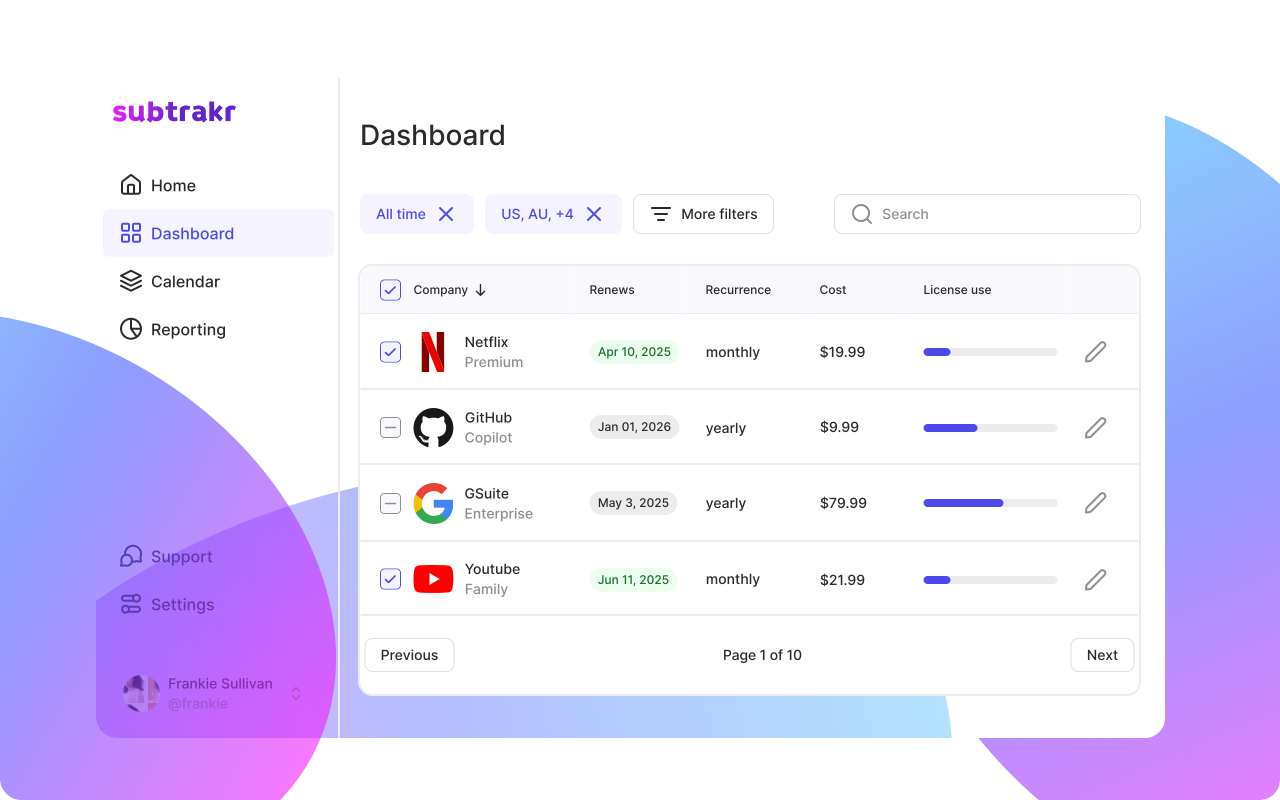
Subtrakr keeps renewal dates, monthly equivalents, and totals in one place so the spend section of your brief is already half done when negotiation season starts.