Quick answer
Annual billing usually saves money on subscriptions (often around 10–20% off the total yearly price) because companies reward you for paying upfront. However, it requires a large upfront payment and a year-long commitment – if you stop using the service early, the discount disappears and you've paid for unused months.
TL;DR:
Annual billing usually saves money on subscriptions (often around 10–20% off the total yearly price) because companies reward you for paying upfront. However, it requires a large upfront payment and a year-long commitment – if you stop using the service early, the discount disappears and you've paid for unused months.
Stay Updated with Subtrakr
Sign up to our newsletter to get updates about Subtrakr and valuable insights about subscriptions and recurring expense management.
Monthly billing ends up costing more over a full year, but it offers the freedom to cancel anytime without a big financial hit. It's paid in smaller chunks, which is easier on your budget and safer if you're unsure about long-term use.
Expert advice: Choose annual plans only for services you're confident you'll use for the long haul (and can afford the lump sum); otherwise, stick to monthly for flexibility and to avoid wasting money on unused service time.
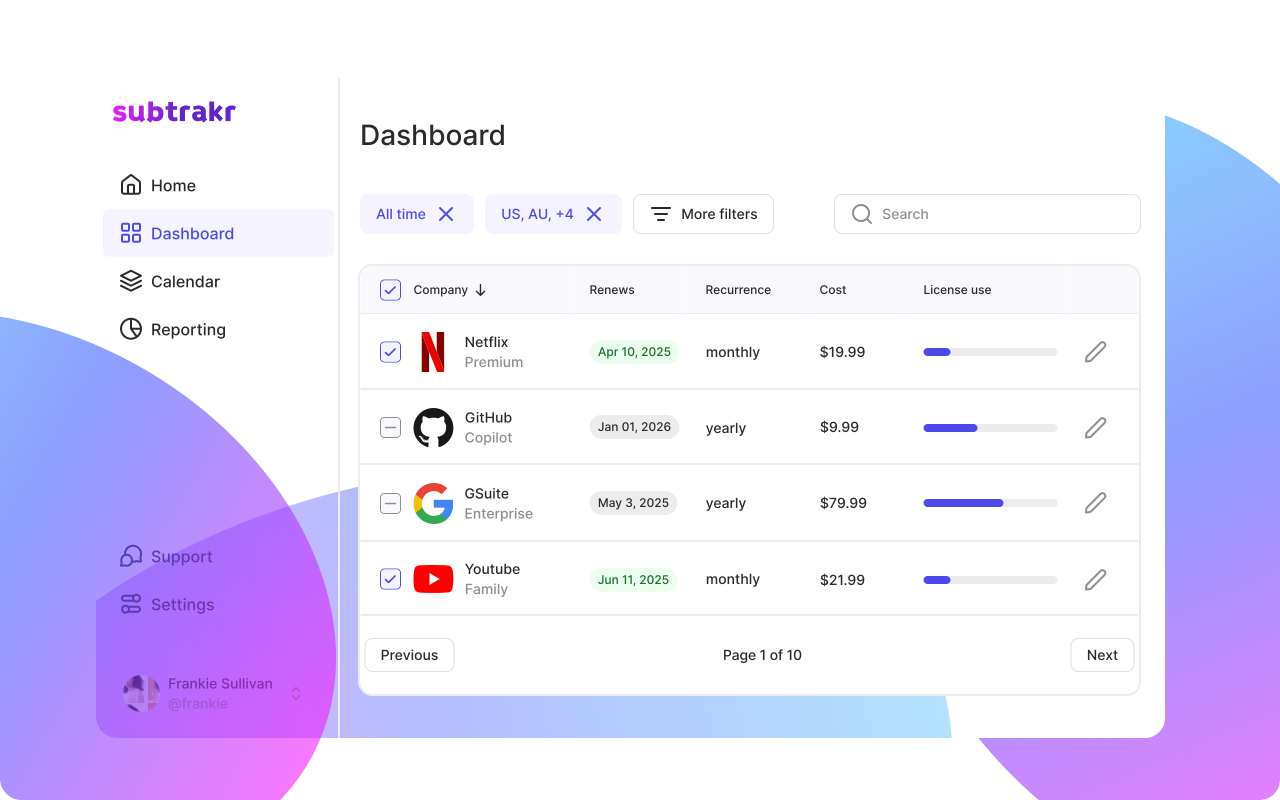
Pro tip: Keep an eye on your recurring expenses with a subscription tracker spreadsheet. A subscription tracker (like Subtrakr) can help you spot forgotten subscriptions and see where an annual vs. monthly plan could save you money on subscriptions.
The Subscription Dilemma: Monthly vs. Annual Plans
From Netflix and Spotify to cloud software and fitness apps, subscription services have become a normal part of our recurring expenses. In fact, the average American household spends over $200 per month on subscriptions – often for multiple services, some of which they may have forgotten about. With so many services on auto-pay, it's no wonder everyone wants to save money on subscriptions wherever possible.
One common tactic is opting for annual billing when it's offered. You've probably seen the pitch: "Pay annually and save 20%!". It's a tempting offer – who wouldn't want to get a discount for something they plan to use all year? Paying for a year upfront usually comes at a lower total cost than paying month by month. But is that yearly plan always the best deal for your wallet, or could it end up costing you more in the long run? The answer isn't one-size-fits-all. It depends on the service, your usage habits, and your financial situation. Let's break down the cost savings and trade-offs of monthly vs annual billing to figure out which option truly saves you more.
Annual Billing: Upfront Cost with Long-Term Savings
Annual subscription plans are attractive for one big reason: cost savings. Service providers typically offer discounted pricing for paying a year in advance, as it guarantees them your business (and cash) for a longer period. For you as the consumer, this often means getting 1–3 months "free" compared to paying twelve monthly installments. In percentage terms, an annual plan can save you roughly 10% to 25% off the total yearly cost.
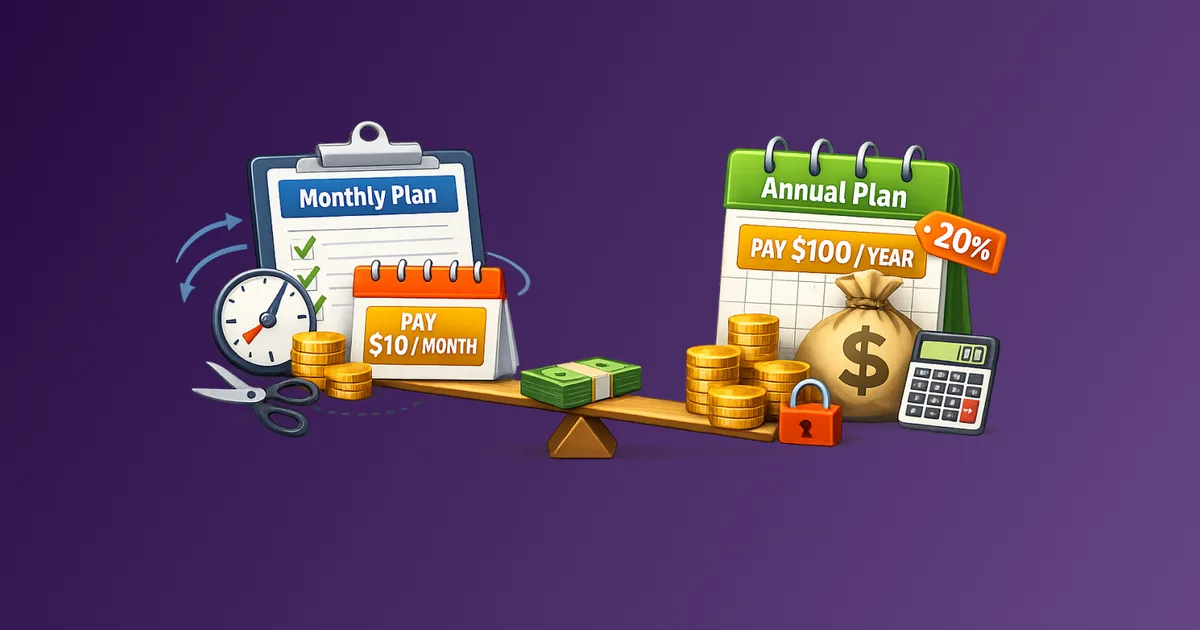
For example, an Amazon Prime membership can be paid monthly at $14.99, or annually at $139. Opting for the annual billing means you'd spend $139 for the year instead of $179.88 – saving about $40 by year's end. That's roughly a 22% discount for paying upfront. Similarly, many software and app subscriptions follow a pattern like $10 per month or $100 per year, rewarding you with savings if you commit to all 12 months at once.
Why do companies give these discounts? It's simple: they lock in your commitment and money. In return, you get a lower per-month price. If it's a service you know and love – something you use consistently as part of your daily or weekly routine – going annual can indeed lead to real savings over the course of a year. You'll also have the convenience of a one-and-done payment (one less recurring charge to remember each month) and protection from any price hikes for the duration of your prepaid period.
However, those savings only materialize if you actually use the service for the full year. The risk with paying upfront is that your circumstances might change. If you stop using the service after a few months, that great deal can turn into a waste of money. As one financial expert put it, if you stop using a yearly subscription three months in, you've effectively paid for nine months of nothing. In other words, the advertised savings assume you'll remain an active user for the entire term.
Key point: Annual billing can save you money on subscriptions you're committed to, but it comes with an upfront cost and a commitment. Before jumping on a yearly plan, make sure the service is something you'll truly value all year round.
Upfront Cost vs. Flexibility: The Trade-Offs
What do you sacrifice for those annual savings? The biggest trade-off is flexibility. A year-long subscription means paying a significant sum upfront and being locked in for the duration. This can be a financial barrier for many people, especially with higher-priced services. Even if the total cost is cheaper in the long run, shelling out a large lump sum at once might strain your budget. As a retirement planning article notes, one-time payments can offer a better deal than monthly fees, but that might not be ideal if you're on a tighter budget or unsure you'll use the service enough.
With an annual plan, you also lose some freedom to change your mind. Let's say after a few months you realize the app or membership isn't as useful as you expected, or life circumstances change – if you've paid for the full year, getting out of it can be tricky. Many services do not offer prorated refunds if you cancel partway through an annual term. You've essentially sunk that cost already (more on the "sunk cost" effect later), so canceling early means eating the loss of the remaining months. In contrast, a monthly plan inherently limits your commitment – you can cancel and stop payments as soon as you decide the service isn't worth it.
Monthly billing shines when it comes to flexibility and cash flow management. By paying month-to-month, you're committing only a smaller amount on a regular basis, which is easier to budget for. If your needs change or a better alternative comes along, you can drop the subscription without losing a large prepaid sum. This freedom can be especially valuable for rapidly evolving services or content platforms – for instance, if a new competitor or a new trend makes one service obsolete, a monthly subscriber can switch quickly, whereas an annual subscriber might feel stuck or waste money.
In short, annual vs monthly is a trade-off between saving money and staying flexible. Annual plans give you a lower price overall but require upfront payment and confidence in long-term use. Monthly plans cost more over time but offer pay-as-you-go flexibility with minimal commitment.
When Monthly Billing Makes More Sense
So, in what situations is sticking to a monthly plan the smarter choice? Here are a few scenarios where monthly billing is safer or more practical:
Trying a new service: If you're not completely sure a subscription will be worth it, go monthly. It's easier to test out new services without a long-term commitment. You can try it for a month or two and see if it fits your needs, canceling if it doesn't.
Short-term or uncertain usage: Consider how long you actually need the service. Are you subscribing for a specific project or a few months of use (like a fitness app for a training program or a streaming service for a show's season)? If you only need it for part of the year, monthly payments will likely cost you less than a full-year lump sum. Why pay for 12 months if you only require 3 or 6?
Tight budget or cash flow concerns: Annual discounts won't help if paying $100 upfront forces you into credit card debt or financial stress. Opt for monthly if the large upfront cost would strain your finances. Smaller monthly fees can be easier to handle and adjust in your budget.
Rapidly changing services or preferences: In fast-moving tech or content areas, what you love today might be replaced by something better tomorrow. For those "maybe I'll use it more later" subscriptions – or ones where a shiny new competitor could pop up next month – committing to a full year can be a gamble. Monthly keeps your options open so you're not locked into an outdated or less useful service.
In these cases, the flexibility of monthly billing outweighs the savings of an annual plan. Freedom to cancel on short notice is like an insurance policy: you might pay a bit extra each month, but you won't get stuck paying for something you no longer want or need.
Behavioral Factors: Will You Actually Cancel (or Keep Paying)?
Money decisions aren't just about math – behavioral economics plays a big role. The choice between monthly and annual billing can subtly influence your habits and mindset.
One factor is the "pain of paying." With monthly billing, you get a reminder of the cost every month, which can prompt you to regularly ask, "Am I still using this enough to justify the fee?". This built-in reality check can be helpful. If you realize you're hardly using a service, you're more likely to notice and cancel it when you see the charge come through each month. In contrast, an annual payment is a one-and-done hit. After paying upfront, you might not feel the cost again for a year, which can lead to "out of sight, out of mind." It's easy to forget about an annual subscription that you paid for six or eight months ago – until the next renewal comes around.
There's also the commitment factor. Paying for a year triggers a psychological bias: "I've already paid for it, so I should make the most of it." This is related to the sunk cost fallacy – our tendency to stick with something because we've already invested money in it, not necessarily because it's providing value. Businesses know this effect well: industry data shows that annual plan subscribers tend to cancel much less frequently (often 30–40% lower churn rates than monthly subscribers). From your perspective, this means if you've prepaid for a service, you're psychologically inclined to keep using it (or at least keep it active) to "get your money's worth". In other words, you might force yourself to use that yearly subscription or delay canceling, even if your interest has waned – simply because you feel locked in by the upfront investment.
On the flip side, the ability to cancel anytime on a monthly plan can make you more ruthless about cutting losses. There's less of a sunk cost feeling when you're only out one month's fee. The downside, however, is that some people may also procrastinate cancellation even with monthly billing – small monthly charges can fly under the radar, quietly draining your bank account if you're not attentive. Whether monthly or annual, it's important to stay mindful of your usage. Don't fall into the trap of "maybe I'll use it later" while it keeps billing you.
Auto-renewal is another behavioral trap. Annual subscriptions usually auto-renew by default, and if you forget to disable that, you could be hit with a surprise charge for the next year. It's a nasty feeling to realize a $100+ charge went through for a service you stopped using months ago because you missed the renewal date. Monthly subscriptions can auto-renew too, of course, but at least the hit is smaller and you have more frequent reminders. Always mark your calendar or set reminders for renewal dates, especially for annual plans, so you can reassess whether to continue or cancel in time. If you want a practical system for this, use this subscription calendar guide.
Crunching the Numbers: A Real Example ($10/Month vs. $100/Year)
Sometimes it helps to see the math in action. Let's say a subscription costs $10 per month or there's an option to pay $100 for a full year (a common scenario, essentially giving you two months free).
If you use the service all year: Monthly payments would total $10 × 12 = $120. The annual plan costs $100. In this case, annual saves you $20 for the year – about a 16.7% savings, which aligns with the typical discounts companies offer for yearly commitments.
If you cancel early (for example, after 6 months): With monthly billing, you would have paid $10 × 6 = $60 for the half-year you used the service. If you paid $100 upfront for the annual plan, you're still out the full $100, even though you only used 6 months' worth. In this scenario, going annual actually lost you $40 compared to sticking with monthly. The breakeven point in this example would be around the 10th month of use – if you use at least 10 out of 12 months, the annual plan is worthwhile; if not, monthly would have been cheaper.
This simple example illustrates a key point: the annual plan only saves you money if you truly need the service for the bulk of the year. If there's a decent chance you won't use it that long, you're better off paying monthly even though the sticker price per month is higher. It also shows why you should be honest with yourself about usage – optimism about "I'll use it all year" can cost you if it doesn't pan out.
Conclusion: Be Strategic to Save Money on Subscriptions
So, which billing cycle saves you more? For definitions of billing cycle, proration, and refund rules that affect mid-cycle changes, see the subscription billing terms glossary. The expert consensus is that it depends on your situation. Annual plans can be a great way to save money on subscriptions you use constantly, typically knocking off a significant percentage of the cost. But you should opt for yearly billing only when you're confident in the service – confident that you'll use it frequently for the entire year – and when you're financially comfortable paying upfront. Think of it like buying in bulk: it's cheaper per unit, but only a good deal if you actually consume all of what you bought.
On the other hand, monthly plans act as a safety net. They might cost a bit more in total over 12 months, but they protect you from over-committing. If you're unsure about a subscription's long-term value or you need the flexibility to cancel on short notice, stick with monthly. Paying a little extra each month can be smarter than paying a lot upfront and regretting it later. As one financial guide advised, a lump payment may not be ideal if you're not sure you'll use the service enough – better to pay as you go until you're sure.
Finally, whichever route you choose, make it a habit to review your recurring expenses regularly. Subscriptions can pile up, and it's easy to lose track. In fact, many people are spending money on services they've forgotten about or no longer use. A good practice is to audit your subscriptions every few months – or use a tool to help. Subscription tracking apps (like Subtrakr) can automatically show you all your active subscriptions, how much you're paying, and even alert you to upcoming renewals. These tools help you spot patterns and identify opportunities to save, whether that means canceling something, downgrading a plan, or switching to annual billing for a service you consistently use. As financial planners note, keeping track of these costs is essential to prevent them from sneaking up on your budget.
Bottom line: Choosing between monthly vs. annual billing comes down to balancing cost and flexibility. To save money, take the annual discount when it truly makes sense – when you love the service, use it often, and have the funds to pay upfront. But if you're not ready to commit, don't feel bad about paying a little extra for monthly; it could save you more in the long run by avoiding unused months. By staying mindful and using smart tools to manage your subscriptions, you can enjoy your services and keep your budget under control – a win-win for your wallet.
If you want a practical decision worksheet you can run in minutes, use Annual vs Monthly Billing Break-Even: Decide in 5 Minutes.
And before you actually prepay, run the checklist in Annual Commitments Without Regret: Guardrails to Set First. Savings only stick when prove-it time, refund rules, and renewal reminders are in place first.
Sources
- Monthly vs. Annual billing – what's the difference?
- Why Annual vs Monthly Pricing Psychology Matters for SaaS Revenue Leaders
- Are Subscriptions Cutting into Your Retirement Savings?
- Annual vs. Monthly: Are You Really Saving Money on Subscriptions?
- Annual vs. Monthly Subscriptions: Which Payment Plan Actually Saves You Money?