Quick answer
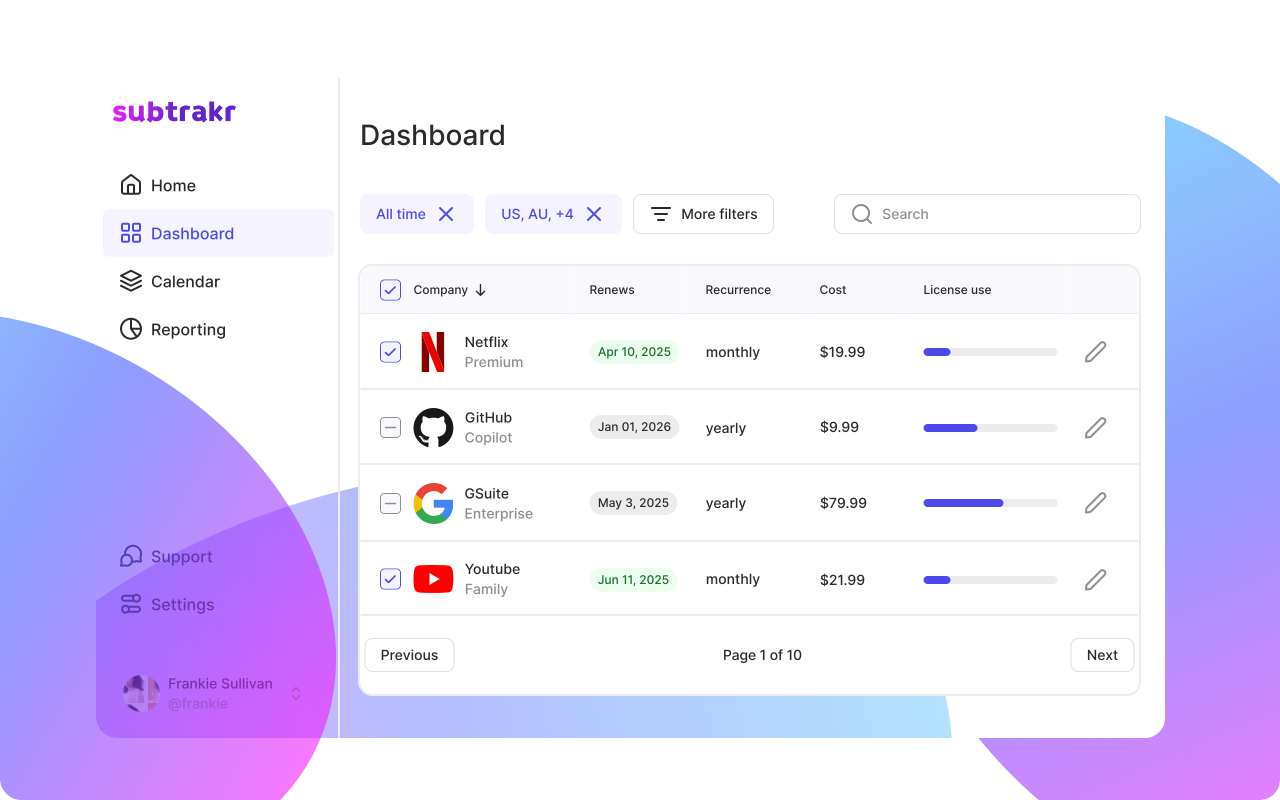
Managing recurring expenses, from housing and utilities to subscriptions and insurance, is crucial for financial health. As Subtrakr evolves from tracking just digital subscriptions to all recurring expenses, it's worth examining how much income people typically spend on these regular costs. Research shows that a significant share of household income goes toward recurring necessities.
Managing recurring expenses, from housing and utilities to subscriptions and insurance, is crucial for financial health. As Subtrakr evolves from tracking just digital subscriptions to all recurring expenses, it's worth examining how much income people typically spend on these regular costs. Research shows that a significant share of household income goes toward recurring necessities. This share varies widely across regions and income levels, but it often falls between one-third and over one-half of total income.
Stay Updated with Subtrakr
Sign up to our newsletter to get updates about Subtrakr and valuable insights about subscriptions and recurring expense management.
Global Average and Why Recurring Expenses Matter
On a global scale, households devote a large portion of their budgets to recurring essential expenses. These include housing (rent or mortgage), food, utilities, transportation, insurance, and other bills that must be paid regularly. Financial planners often recommend keeping "needs" to around 50% of take-home pay (as in the popular 50/30/20 budget rule), but many people exceed that guideline. In the United States, for example, core living expenses (like housing, electricity, car costs and insurance) account for about 31% of household spending on average. An economics professor at UNM noted that this isn't alarming compared to other countries, and he would only be concerned if essentials approached ~45% of income. In fact, a separate analysis found that typical U.S. households spend roughly 40% of their monthly income on household bills (about $2,058 out of $5,174 median monthly income). Importantly, that 40% figure excludes groceries, clothing, and other discretionary purchases, meaning if we include all necessities like food, the percentage of income going to recurring needs would be even higher (often around half of income).
Why does this matter? Because money tied up in recurring obligations can limit one's ability to save or spend on other goals. Whether you're an individual managing personal finances or a solopreneur running a small business, recurring expenses tend to "lock in" a chunk of your income every month. Understanding what percentage of income these costs consume and how that compares to norms can help identify opportunities to budget better or cut unnecessary spending.
Regional Differences in Recurring Expense Burdens
Household spending patterns vary by region, but one clear trend is that wealthier countries spend a smaller percentage of income on basic recurring needs than lower-income countries do. In broad terms:
North America (U.S. and Canada)
Recurring expenses take up roughly one-third to two-fifths of household income on average. We've seen that U.S. households spend about 31–40% on core recurring bills. Housing alone often approaches the largest chunk. Americans spent about 25–30% of their pretax income on housing costs in recent years, and about half of Americans now spend over 30% of their income just on housing (rent or mortgage plus utilities and insurance). In Canada, trends are similar: housing and utilities are the top expenses, while food typically comprises under 10% of spending. Overall, North American households tend to have a needs budget around the 30–40% range of income, leaving the rest for taxes, savings, and discretionary spending.
Europe
In Europe, housing and utility costs also dominate budgets. In 2019, households in the EU spent 23.5% of their total consumption on housing, utilities and fuels, making it the single largest expenditure category. Food was the third-largest expense at about 13.0%, and transport was close behind at 13.1%. Combining these recurring necessities (housing, utilities, food, basic transport) shows that roughly 35–40% of European household spending goes to recurring essentials. This is comparable to the U.S. share. Within Europe there is variation: for example, in Romania, food eats up 26% of spending (one of the highest in EU), whereas in richer countries like Ireland or Luxembourg, food is less than 10%. Still, housing-related expenses over 25% of consumption are common in many European countries (e.g. UK, France, Denmark). Europe's extensive social safety nets (healthcare, etc.) mean out-of-pocket medical costs are smaller than in the U.S., but Europeans still devote a similar fraction of their budgets to recurring living costs, especially housing.
Asia, Africa, and Developing Regions
In lower-income countries, a much larger percentage of income goes toward recurring necessities, primarily food and basic utilities. It's not uncommon for families in developing economies to spend over half of their income on food alone. For instance, households in Bangladesh spend about 53.5% of their expenditures on food, and those in Myanmar (Burma) spend an average of 56.1% on food. By contrast, food accounts for just 6–9% of household spending in the U.S. and around 8–13% in most Western European countries. This huge gap reflects higher incomes and more disposable wealth in developed countries. Affluent households spend a smaller slice of their budget on basic groceries, whereas poorer households must dedicate the bulk of their limited income to keep food on the table. As a result, total recurring expenses (food, housing, fuel, etc.) in many developing nations can easily reach 60%+ of income. In some cases, food alone exceeds housing as the top expense (e.g. Nigeria, Bangladesh, Kenya), whereas in industrialized nations housing typically overtakes food as the largest cost. Overall, the poorer the country (or household), the higher the share of income absorbed by recurring essentials – leaving very little room for savings or non-essential spending.
These regional differences illustrate why tracking recurring expenses is so important. In parts of the world where essentials consume most of the income, even small price increases can be devastating to households. Meanwhile, in wealthier regions, recurring expenses still represent the largest drain on income, even if the percentage is lower. Every extra dollar (or euro) spent on an unneeded recurring bill is money that can't go toward investments, education, or growth, a concern for individuals and small businesses alike.
Breakdown by Expense Category
Let's look at common categories of recurring expenses and what share of income or budget they typically command. Keep in mind these are broad averages; individual situations will vary, but they provide a benchmark for planning a budget:
If you are building a personal inventory (not just benchmarks), use How to Track Non-Subscription Recurring Expenses: Rent, Insurance, Utilities, and Payroll as a category checklist—then compare your totals to the ranges below.
Housing (Rent or Mortgage)
This is often the single biggest recurring expense for most people. Financial experts suggest keeping housing costs around 30% of income, yet many exceed that. In the U.S., housing (including utilities and property taxes) averaged about 25–26% of pre-tax income in 2022. Median figures hide that many households pay much more, as noted, about 50% of Americans pay over 30% of income on housing, a level considered "cost-burdened." Similar patterns hold in other countries. In the UK, for example, housing and energy took roughly 27% of household spending in recent years (and even more after recent energy price increases). High housing costs are particularly challenging for lower-income families: in the U.S., households in the bottom income third spent around 40% of their income on housing, and for the poorest renters it was nearly half of their income going just to shelter. By contrast, higher-income households might spend only 15-20% on housing. Key point: Around 20–35% of income for most households goes to housing costs, making it the top priority to monitor. If your housing expense is much beyond one-third of income, it can squeeze out other financial goals.
Food and Groceries
Groceries are another fundamental recurring expense (you literally "consume" this part of your budget regularly!). The share of income spent on food varies enormously by income level. As discussed, in poorer countries food can consume over 50% of expenditures (e.g. 53% in Bangladesh). In wealthier nations, food's share is far lower thanks to higher incomes and cheaper food relative to earnings, for instance, U.S. households spend only about 6.4% of their expenditures on food at home on average, and total food including dining out is roughly 10-12% of the budget. EU averages are around 13% on food, but with wide variation (Central/Eastern European countries tend to have higher food budget shares than Northern/Western Europe). It's worth noting that food costs are one area individuals and small businesses (like restaurants or food vendors) feel differently: individuals can adjust grocery choices to some extent, while small businesses in food service see food input costs as a recurring expense that directly affects margins. Key point: Food typically takes 10–15% of spending in higher-income households, and significantly more in lower-income households. Tracking grocery spending can reveal trends like "food inflation" eating into your budget, or uncover if dining out (which is discretionary) is pushing this category higher than it needs to be.
Utilities and Household Bills
Utilities (electricity, water, heating gas), along with other household bills like internet, phone, and cable TV, are recurring expenses that often come with monthly invoices. Individually, each utility may be a relatively small percentage of income, but together they add up. For example, in the U.S. the typical monthly utility bills are around $120 for electricity, $86 for water/sewer, $71 for natural gas, and about $96 for mobile phone service. Combined, those basic utilities easily total a few hundred dollars per month. If we take a median U.S. monthly income (~$5,000), core utilities might be roughly 5–10% of income. In Europe, utility costs vary (Nordic countries have high electricity costs but lower usage, some countries have government caps or subsidies). In any case, keeping the lights, heat, and internet on is a non-negotiable recurring cost for virtually everyone. Businesses also face utility bills (electricity, water, internet for an office or storefront) which can form a significant overhead. Monitoring these can uncover opportunities to save, for instance, improving energy efficiency to lower electricity costs. Key point: Expect around 5% (up to 10%) of income to go to basic utilities and communications bills. This can spike during extreme weather (air conditioning or heating season) or if one has premium plans, so it's wise to budget a bit extra for utilities in your recurring expense plan.
Transportation
Transportation expenses can be partly recurring (and partly variable). If you own a car, you likely have a car loan or lease payment (recurring monthly), auto insurance (often paid monthly), and fuel and maintenance (recurring but fluctuating). Public transit commuters might pay monthly transit passes. In the U.S., transportation is the second-largest spending category after housing, averaging about $1,024 per month in 2022, that's roughly 17% of the average household's monthly expenses. This figure includes car purchases and gas. If we isolate recurring portions: the average auto loan payment is about $470 per month in the U.S. according to one survey, and auto insurance around $105 per month. Those combined $575 is about 11% of a $5,000 income. Adding fuel could bring transportation's recurring cost to ~15% of income for a typical driver (gasoline itself isn't a fixed bill but is a regular expense). In Europe and Asia, scenarios differ; cities with good public transit see lower personal transport costs, whereas areas with long commutes by car incur higher costs. Small business owners with vehicles (delivery vans, etc.) also face these ongoing transport costs. Key point: Transportation often accounts for 10–15% of household spending. It's a necessary recurring cost for most, but one that savvy planning (fuel-efficient vehicles, utilizing transit, etc.) can optimize.
Insurance and Healthcare
Many insurance premiums are paid monthly or annually: health insurance, auto insurance, homeowner's or renter's insurance, life insurance, etc. These are classic recurring expenses – you pay for peace of mind and protection. The share of income this takes can vary hugely by country due to different healthcare systems. For example, in the U.S. the consumer's direct health insurance costs and out-of-pocket medical spending is very high – health expenditures make up about 20.8% of U.S. household consumption on average (the single largest spending category in the U.S. by some measures). The doxo report data showed a median of $72 per month in consumer-paid health insurance premium (likely for those buying their own plans), that's on top of what employers or government programs pay. In countries with public healthcare, individuals pay less directly (though they pay via taxes). Auto and property insurance typically add a few percentage points of income in most budgets. For instance, U.S. households pay about $105/month on auto insurance (2% of income) and ~$60 on life insurance. Key point: Insurance and healthcare costs can range from a small fraction of income (in countries where the state covers healthcare) to a major chunk (in the U.S., health + insurance can easily be 10-20% of income combined). It's crucial to include these in any recurring expense review since they are easy to "set and forget" on auto-pay, even as premiums rise annually.
Subscriptions and Miscellaneous Services
Finally, we have the category that inspired Subtrakr's origins – subscriptions. This includes streaming services (Netflix, Spotify), gym memberships, software subscriptions (for solopreneurs this might be your web hosting, Shopify, or Adobe Creative Cloud), and other monthly services. Individually, each subscription might be small, but people often accumulate many. A recent survey found Americans spend about $91 per month on subscription services on average but notably, many underestimate this total, often forgetting some active subscriptions. $91 is only around 1–2% of the average household income, which is relatively small compared to housing or food. However, these expenses are highly controllable, they're "wants" more than "needs" in most cases. Small businesses also have to watch subscription creep (e.g. paying monthly for multiple SaaS tools). Key point: Subscriptions may only be a few percent of your income, but they are one area where consolidating or canceling unused services can free up cash. In the context of recurring expenses, subscriptions are the low-hanging fruit to trim, whereas big-ticket items like rent or car payments are harder to change in the short term.
Impact of Income Level on Recurring Expenses
It's important to note that income level dramatically affects these percentages. Lower-income individuals spend a much higher proportion of their earnings on necessities than higher-income individuals do. We touched on this with food and housing shares. To underscore the point: one analysis showed that about two-thirds of lower-income families' spending goes to core needs (housing, food, transportation), leaving very little for anything else. In fact, by 2014, the lowest income tier of U.S. households on average had no slack at all – they were spending slightly more than their income each year on basic expenses, often by going into debt. Another study noted nearly 75% of expenditures for families living in or near poverty go to just five necessities: food, transportation, rent, utilities, and cell phone service (all of which are recurring costs). In contrast, higher-income households spend a smaller fraction of their paycheck on essentials which allows them to save or afford non-essentials. This gap explains why unexpected price hikes (like a surge in food or fuel prices) hurt low-income families the most: since they're already devoting most of their income to recurring necessities, there's no wiggle room.
For middle-class households, recurring expenses still take up the majority of spending – for example, one Pew Charitable Trusts study found that about 2/3 of the average American family's expenditures went to housing, food, and transport. That left one-third for everything else (health care, education, entertainment, savings, etc.). Higher earners might manage to keep needs at 50% or less of income, aligning with classic budget advice. The bottom line is that knowing your personal "recurring expense ratio", the percentage of your income that goes to must-pay expenses each month, is vital, because it indicates how much flexibility you have. If that ratio is very high (say 80-90%), you are walking a financial tightrope. If it's moderate (around 50%), you have some breathing room. And if it's low (perhaps 30% or less), you have significant flexibility to save or handle emergencies. Tracking recurring costs is the first step to improving this ratio.
Why Tracking Recurring Expenses Is Critical for Everyone
Whether you're an individual trying to build savings, a solopreneur managing a business budget, or a family running a household, recurring expenses form the backbone of your financial obligations. These expenses hit your accounts on a regular schedule, and they generally can't be avoided without major life changes. By researching how much of your income should (or does) go to recurring expenses, you gain insight into your financial stability.
A few takeaways from the data:
Globally, many households spend 30–50% (or more) of income on recurring needs. In wealthy countries it's toward the lower end of that range (around one-third on average), while in lower-income regions it's toward the higher end (half or beyond on essentials). There is no one "right" number, but if your own budget is far out of line (for instance, if you live in a high-income country yet 70% of your income goes to recurring bills), it's a red flag to investigate.
Housing tends to be the largest single recurring expense worldwide, so keeping housing costs manageable has a huge impact. Even small business owners find that rent or mortgage for business space can make or break profitability. Aim for housing near or below 30% of income if possible, a goal that many struggle with, but experts warn that much above that can lead to financial strain.
Other recurring categories like food, utilities, and transport are substantial too, and they cumulatively rival housing in total impact. In an average American budget, for example, housing was ~$2,000/month and all other recurring categories (food, transport, insurance, etc.) summed to another ~$2,000+. That means after covering recurring costs, the average household had only ~23% of income left (the remainder went to taxes or savings). Knowing this, it becomes clear why careful monitoring of each recurring line item is necessary. Little leaks in multiple categories can together sink the whole ship of your finances.
Income growth doesn't automatically lower your recurring expense share – people often "upgrade" housing, cars, or lifestyles as income grows, keeping the percentage on needs relatively high. However, maintaining a lower percentage (a form of lifestyle discipline) can dramatically improve financial security. Tools like Subtrakr, which now track all recurring expenses, can help identify where your money is going and shine light on patterns. Maybe you'll discover you're paying for ten different software subscriptions for your small business when a consolidation could cut that in half, or that your household is still subscribing to services you don't use.
In summary, recurring expenses typically consume a large chunk of income, roughly a third in the best case for middle-income households, and often well over half for those with tighter finances. This holds true across the globe, though the balance between categories shifts with economic development. By researching and understanding these averages, you can benchmark your own spending. More importantly, by actively tracking and managing recurring expenses, you can work to reduce their share of your income (for example, negotiating a better deal on an insurance premium, cutting unused subscriptions, or finding ways to save on utilities). Every percentage point of income freed from a recurring bill is a percentage that can go into savings, investments, or growing your business. That's why this kind of analysis isn't just academic, it's key to financial well-being for individuals and entrepreneurs alike.
If you want to apply these benchmarks inside a simple 50/30/20-style allocation with subscriptions handled explicitly, use The 50/30/20 Rule for Recurring Expenses: A Subscription-Friendly Version.
Sources
- U.S. Bureau of Labor Statistics Consumer Expenditure Survey via Chase (2022 data) – average household income and spending breakdown.
- doxo 2025 U.S. Household Bill Pay Report via GoBankingRates – median American household bill expenses (~40% of income on 13 recurring bill categories).
- KOAT News, Apr 2025 – Study showing ~31% of U.S. household spending goes to core essentials (mortgage, utilities, insurance, etc.), with expert commentary on international comparison.
- Eurostat (2019 data) – European household expenditure shares by category (housing 23.5%, food 13% of spending, etc.).
- CIA World Factbook (2018 data) – Percentage of household expenditures on food in various countries (e.g. ~6.4% US vs 53.5% Bangladesh), illustrating regional disparities.
- Pew Charitable Trusts analysis of U.S. spending by income tier – How lower-income vs upper-income households allocate spending (e.g. lower third spends ~40% on housing alone).
- NerdWallet Survey 2025 via InvestigateTV – Nearly half of Americans now spend ≥30% of income on housing, versus the ~28% recommended, reflecting housing affordability issues.
- CNET survey via ABC7 News – Average American spends about $91 per month on subscription services, often unknowingly, highlighting the growth of small recurring charges.
- OECD Affordable Housing Database (2024) – International comparison of spending: ~24% of consumption on housing in OECD on average; notes that in some countries food still outpaces housing in budget share.
- Additional data from Bureau of Labor Statistics, NerdWallet, and others embedded in the discussion above.