Quick answer
A finance-friendly tag taxonomy assigns every recurring expense at least two tags: an entity tag (which legal entity or brand owns the cost) and a category tag (what the expense actually is). Shared tools get a third tag, an allocation method, so the monthly cost can be split without a manual spreadsheet each time books close.
Running more than one legal entity, brand, or cost center means every recurring expense needs to answer two questions at once: what is this tool, and who pays for it. Most subscription trackers only answer the first question. That gap is where finance teams lose hours every close, reconciling a shared Slack or AWS bill across entities that accounting already has clean rules for.
Stay Updated with Subtrakr
Sign up to our newsletter to get updates about Subtrakr and valuable insights about subscriptions and recurring expense management.
What Makes a Tag Taxonomy "Finance-Friendly"?
A tag taxonomy is finance-friendly when it mirrors the categories your accounting system already uses, rather than inventing a parallel structure that someone has to translate every month. If your chart of accounts separates software costs by department or entity, your subscription tags should use the same labels, not a looser version of them.
The test is simple: could someone in accounting take your tagged expense list and drop it into the general ledger without renaming anything? If the answer is no, the taxonomy is built for convenience, not for close.
What Tags Does a Multi-Entity Business Actually Need?
Three tag layers cover most cases without becoming unwieldy.
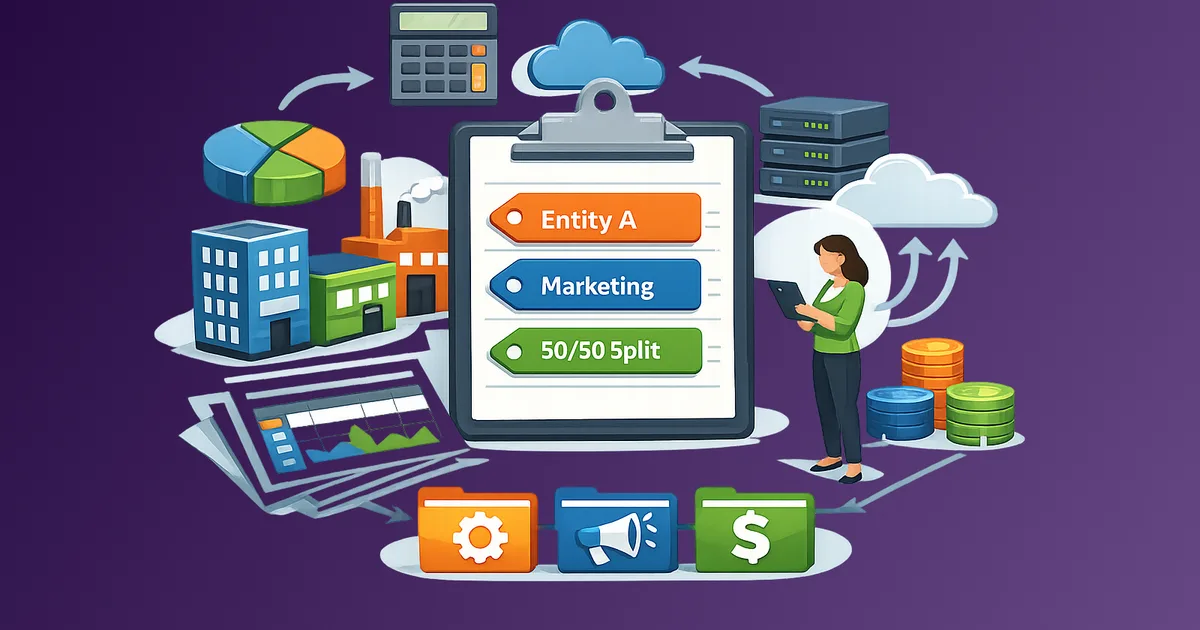
- Entity tag: The legal entity or brand that owns or is billed for the expense (e.g., Entity A, Entity B, Shared Services)
- Category tag: The functional type of spend (e.g., Engineering Tools, Marketing SaaS, HR & Payroll, Finance & Ops)
- Allocation tag: How a shared cost is split when one subscription serves more than one entity (e.g., Headcount Split, Revenue Split, Flat 50/50, Direct Bill)
A fourth optional tag, owner, identifies the person or team responsible for renewal decisions. This matters more as the subscription count grows past what one finance person can track from memory.
How Should Shared Subscriptions Be Tagged?
Shared tools, the ones used across every entity, like a company-wide Slack, a shared AWS account, or a single Zoom license pool, are where most tagging systems break down. The fix is to tag the subscription once at the parent level and record the allocation method as its own field rather than splitting the subscription into duplicate entries per entity.
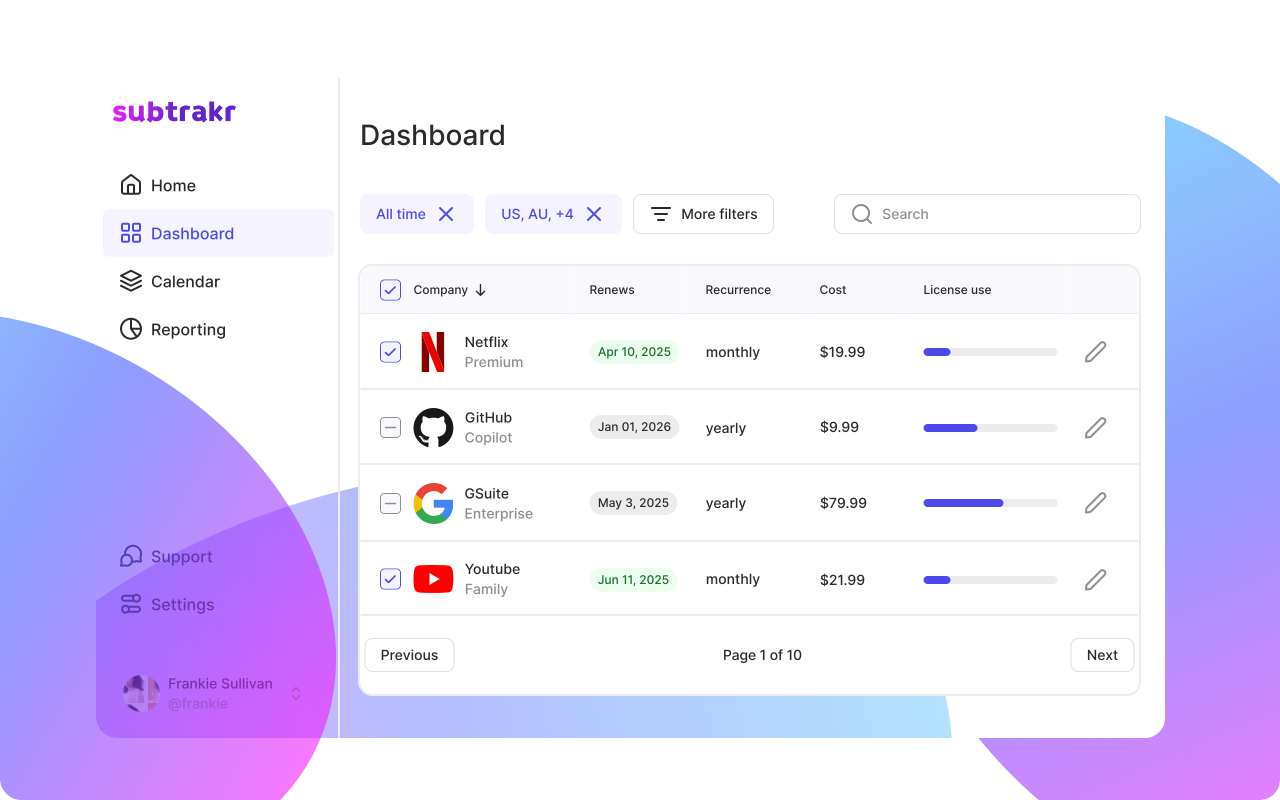
For example, a single $2,400/month cloud hosting bill tagged Entity: Shared Services, Category: Infrastructure, Allocation: Headcount Split tells finance everything needed to run the split at close, without three separate line items that have to be reconciled back into one true total. In Subtrakr, this looks like tagging the subscription once and using notes or a naming convention to record the allocation logic, so the true monthly cost stays visible as a single number while the allocation detail sits alongside it.
Step-by-Step Setup (Time required: 25 minutes)
- Pull your chart of accounts categories. List the software and services categories your accounting system already uses. Do not invent new ones.
- List your entities. Include every legal entity, brand, and any "Shared Services" or "Corporate" bucket that owns cross-entity tools.
- Tag every active subscription with Entity + Category. Start with the highest-cost items first; they carry the most reconciliation weight.
- Flag shared subscriptions and assign an allocation method. Headcount split, revenue split, and flat split cover most real cases.
- Add an owner tag if more than one person manages renewals. This prevents a shared tool from having no clear decision-maker at renewal time.
- Review the tagged list against last month's close. Confirm the categories map cleanly to what accounting recorded. Adjust labels, not structure, if something does not match.
Copy-Paste Tag Structure
Entity: [Entity A / Entity B / Shared Services / Corporate]
Category: [Engineering / Marketing / HR & Payroll / Finance & Ops / Infrastructure / Other]
Allocation (shared only): [Direct Bill / Headcount Split / Revenue Split / Flat Split]
Owner: [Name or team]
Apply this structure consistently, and the tagged list becomes something finance can use directly rather than a reference someone has to reinterpret.
Common Mistakes
- Tagging by vendor instead of category. "Salesforce" is a vendor, not a category. Tag it Category: Sales Tools so it rolls up correctly even if the vendor changes.
- Splitting shared subscriptions into duplicate line items. This inflates the visible subscription count and makes the true monthly cost harder to see, not easier.
- Inventing categories that do not exist in the chart of accounts. Every category that does not map to an existing accounting line becomes a manual translation step at close.
- Leaving allocation undefined until close. If nobody agrees on the split method in advance, close becomes the place where that argument happens, under time pressure.
- No owner tag on shared tools. Shared subscriptions without a named owner tend to renew by default, since no one feels responsible for the cancel-or-keep decision. Assign that person with a spend ownership matrix before the tag is just a label.
FAQ
Do I need separate subscription trackers per entity?
No. One tracker with consistent entity tags is easier to reconcile than several disconnected trackers, since it keeps the full recurring expense picture in one place.
What if two entities share a subscription with different usage levels?
Use an allocation tag based on the metric that reflects actual usage, such as headcount or seats, rather than defaulting to a flat 50/50 split.
Should contractors or per-project tools get their own entity tag?
Only if they are billed and reported separately in accounting. Otherwise, fold them into the category tag under the entity that requested the tool.
How often should the tag taxonomy be reviewed?
Quarterly, alongside a regular recurring expense audit, is enough for most multi-entity businesses. New entities or restructuring are the other trigger points.
Does this replace the need for an accountant's categorization at close?
No, it reduces the translation work at close. Accounting still owns the final categorization; the tagging system just means less time spent re-deriving what each subscription is and who owns it.
Can this taxonomy work for a two-brand company, not just multiple legal entities?
Yes. Brands within a single legal entity work the same way, using the entity tag field for the brand name instead of a separate legal entity.
Next Action
Pull your chart of accounts categories and your entity list this week, then tag your ten highest-cost recurring expenses first. That covers most of the reconciliation weight before the next close.