Quick answer
Auto-renewal clauses lock you in by default. Price cap clauses limit how much vendors can raise rates without renegotiation. Notice periods determine how much lead time you have to cancel or renegotiate. These three clauses, in combination, either protect your budget or quietly erode it. Most SaaS contracts favor the vendor on all three by default.
Most SaaS contracts are renewed automatically. Most buyers do not read them until after the price increases. That gap between "we agreed to this" and "we did not realize what we agreed to" is where a significant portion of B2B software spend quietly disappears.
Stay Updated with Subtrakr
Sign up to our newsletter to get updates about Subtrakr and valuable insights about subscriptions and recurring expense management.
This article focuses on the three contract clauses that have the largest direct impact on what you actually pay: auto-renewal terms, price caps, and notice periods. Understanding these before you sign, and before each renewal, is the most actionable thing a finance-aware buyer can do. Treat exit terms as part of a broader pre-purchase procurement checklist that also covers security, SSO, seat model, and data export.
What is an auto-renewal clause and why does it matter?
An auto-renewal clause means your subscription renews automatically at the end of the contract term unless you take action to cancel or renegotiate within a defined window. If that window passes, you are committed for another full term, often 12 months.
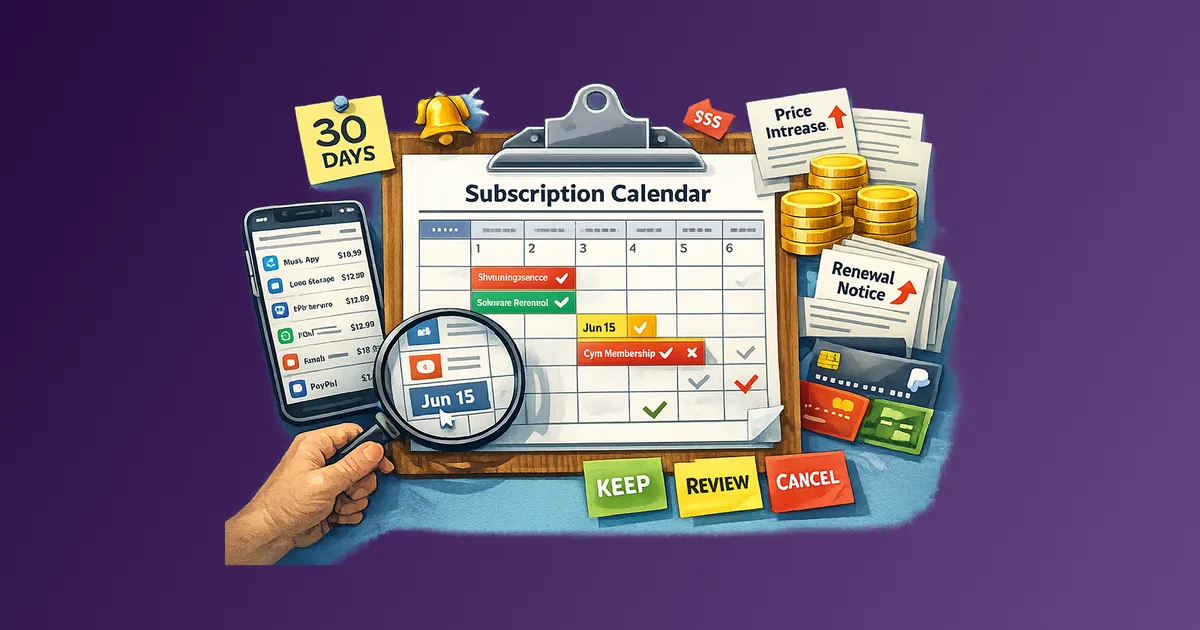
The reason this clause matters financially is not the renewal itself. Renewals are expected. What catches buyers off guard is the combination of auto-renewal with a locked notice period. You may have 30, 60, or 90 days to act before the renewal date, but if no one in your organization is tracking that deadline, the window closes without you. The contract renews at whatever price the vendor has set, and you have no contractual leverage until the following year.
For companies running multiple SaaS tools, the compounding effect is significant. Each tool with an auto-renewal clause is a separate renewal deadline. Miss enough of them and your software budget has grown by 15 to 25 percent without a single deliberate decision.
What to look for in the clause:
- How far in advance must you notify the vendor to cancel or renegotiate?
- Is notice required in writing and to a specific contact?
- Does the auto-renewal lock in the same price or allow for increases?
- Is there a grace period if you miss the notice window?
What is a price cap clause and how much can it save?
A price cap clause limits how much a vendor can increase the price at renewal without triggering a renegotiation or giving you the right to exit. Common formulations tie the cap to CPI (Consumer Price Index), a fixed percentage (often 3 to 5 percent), or a combination.
Without a price cap, a vendor can increase pricing by any amount at renewal. In practice, increases of 10 to 30 percent have become more common in the SaaS market, particularly as vendors shift from growth-mode pricing to margin-focused pricing. If your contract has no cap, you have no contractual protection against those increases. Your only options are to accept, negotiate from a weak position after the fact, or attempt to cancel, which the auto-renewal clause may have already foreclosed.
With a price cap, the calculus changes. A vendor cannot offer you a 20 percent increase if your contract limits annual adjustments to CPI plus 2 percent. They must either honor the cap or renegotiate with you, which restores your position as a decision-maker rather than a passive recipient of a new invoice.
Price caps matter most for:
- Multi-year contracts where inflation compounds over the term
- Tools deeply embedded in your workflow (switching costs are high)
- Vendors with a history of post-growth-stage price normalization
- Any software licensed on a per-seat basis in a growing team
What to negotiate:
- Annual cap tied to CPI or a fixed ceiling (3 to 5 percent is reasonable)
- A "price match" clause that lets you exit if the vendor raises rates above cap without renegotiation
- A written commitment that add-on or feature pricing follows the same cap logic
What is the notice period and when does it become a trap?
The notice period defines how far in advance of the renewal date you must notify the vendor if you intend to cancel, downgrade, or renegotiate. Typical ranges are 30, 60, or 90 days, though some enterprise contracts require 90 to 180 days.
The trap is not the notice period itself. Giving a vendor 60 days' notice is reasonable. The trap is when the notice period is buried in the agreement, the renewal date is not tracked proactively, and the window closes before anyone realizes it. At that point, the auto-renewal clause activates and you are locked in.
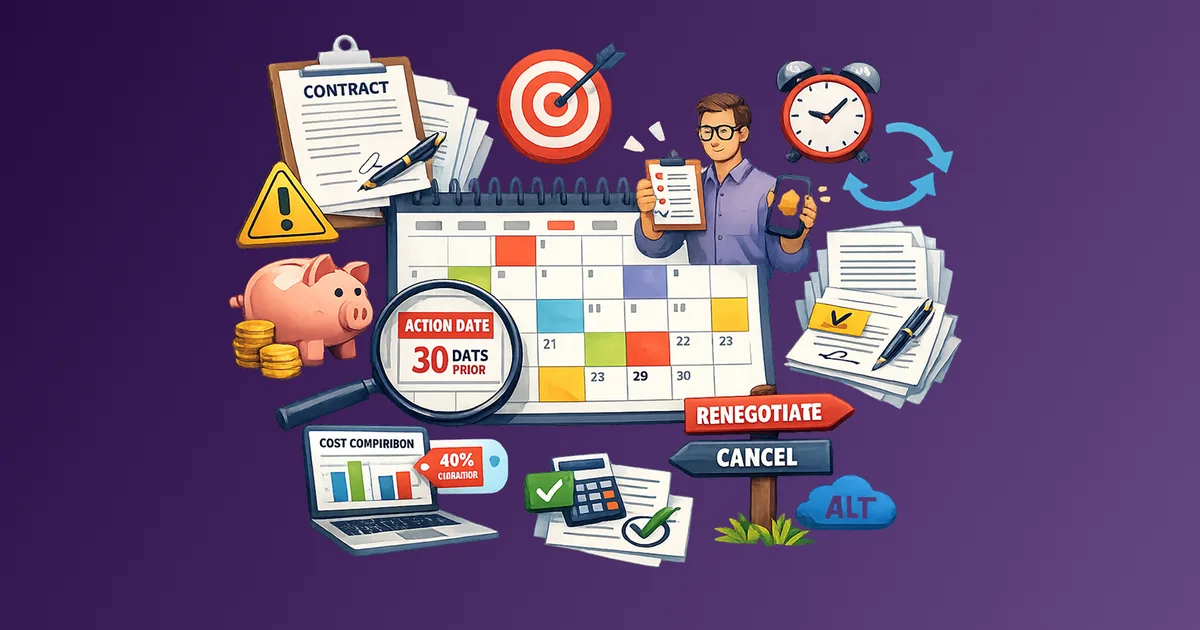
Notice periods also interact with your internal decision-making timeline. If your finance team requires 30 days to approve any contract renewal, and your legal team requires another 14 days to review amendments, and the vendor requires 60 days' notice before renewal, you need to begin the process at least 104 days before the renewal date. Most organizations do not operate with that kind of forward visibility into their SaaS portfolio.
This is exactly where a structured renewal tracking system changes the outcome. When you know each renewal date and the associated notice period, you can reverse-engineer when the review process needs to start.
Clear notice windows and exit terms also reduce disputed renewals when you are the seller. If you bill recurring SaaS charges, pair contract hygiene with the process and communication checklist in Chargeback Prevention for Legitimate Recurring Charges.
How do these three clauses interact?
Individually, each clause is manageable. The risk compounds when they appear together with vendor-favorable defaults.
Consider this scenario: a $24,000 annual SaaS contract auto-renews unless you provide 90 days' notice, and there is no price cap. You miss the notice window by two weeks. The vendor sends a renewal invoice with a 22 percent price increase. You are now locked in for another year at $29,280 with no contractual right to refuse, and no notice window remaining to trigger a cancellation.
This is not a hypothetical. It is a documented pattern in B2B SaaS procurement, and it is more common among mid-market buyers who lack dedicated procurement resources.
The reverse also holds. When all three clauses are negotiated in the buyer's favor:
- Auto-renewal requires only written notice 30 days in advance
- Price increases are capped at CPI plus 3 percent
- The notice period fits within your internal approval timeline
That combination means you retain control at every renewal cycle. You can act if pricing moves unfavorably, and your budget is not exposed to unilateral changes.
What other clauses affect renewal cost?
Auto-renewal, price caps, and notice periods are the three highest-leverage clauses. There are several others worth reviewing before signing:
Evergreen clauses extend the contract indefinitely after the initial term on a rolling basis. These are similar to auto-renewal but often have shorter cycles (monthly rather than annual) and different notice requirements.
Minimum commitment clauses require you to maintain a minimum number of seats or usage level for the contract term. If your team shrinks or usage decreases, you still pay the minimum. Combined with auto-renewal, this locks in a cost floor regardless of actual value received.
Price protection clauses (distinct from price caps) guarantee that existing customers will not be charged more than new customers for the same tier. These are rare but worth requesting for high-value contracts.
Termination for convenience clauses give you the right to exit the contract before the end of the term, often with a fee. Even with a penalty, this clause can be worth more than being fully locked in if the vendor's product or pricing deteriorates significantly.
Common mistakes buyers make at SaaS renewal
Reviewing the contract only once, at signing. Contracts should be reviewed annually, at minimum 90 days before each renewal date, not just at signature.
Treating the notice deadline as the start date for review. The notice deadline is the end of your review window, not the beginning. By the time the window opens, you should already have a decision framework in place.
Assuming the price in the renewal invoice matches the contract. If there is no price cap clause, the renewal price is at the vendor's discretion. Always verify the invoice against the contract before the payment is processed.
Negotiating only at signing. Mid-term is often a better time to negotiate additions or amendments than at renewal, when your leverage is lower. Vendors are more receptive to upsells mid-term than to discounts at renewal.
Not tracking renewal dates centrally. If your SaaS contracts are distributed across email inboxes, department budgets, and individual credit cards, there is no practical way to manage renewal windows proactively. Centralizing your recurring expense tracking is a prerequisite for managing these clauses effectively.
Copy-Paste: SaaS Contract Renewal Clause Checklist
Use this checklist before signing or renewing any annual SaaS contract:
SaaS Contract Renewal Clause Checklist

Auto-Renewal
[ ] Confirmed: does this contract auto-renew? (Yes / No)
[ ] Renewal term length: ___________
[ ] Notice required to cancel or renegotiate: ___ days
[ ] Notice must be sent to: ___________
[ ] Notice must be in writing: (Yes / No)
[ ] Grace period if notice is missed: ___________

Price Cap
[ ] Is there a price cap at renewal? (Yes / No)
[ ] Cap type: CPI / Fixed % / Other: ___________
[ ] Cap percentage: ___%
[ ] Does cap apply to per-seat and add-on pricing? (Yes / No)

Notice Period
[ ] Notice deadline date (renewal date minus notice days): ___________
[ ] Internal review start date (notice deadline minus internal lead time): ___________
[ ] Who is responsible for initiating review: ___________
[ ] Confirmed: renewal date is tracked in our renewal calendar: (Yes / No)

Other Clauses to Review
[ ] Is there a minimum commitment clause? ___________
[ ] Is there a termination for convenience option? ___________
[ ] Is there a price protection or most-favored-nation clause? ___________
[ ] Any evergreen provisions? ___________
FAQ
What happens if I miss the SaaS cancellation notice period?
In most cases, the contract auto-renews for the full term at the vendor's then-current pricing. Your options at that point are to accept the renewal, negotiate informally (with limited leverage), or attempt to exit with a financial penalty if the contract includes a termination for convenience clause.
Can I negotiate auto-renewal terms after signing?
Yes, particularly at mid-term or when the vendor initiates a pricing discussion. Mid-term is often better leverage than at renewal. Tie any amendment to a concrete benefit for the vendor (committing to a longer term, adding seats) in exchange for improved cancellation flexibility.
Is a 90-day notice period normal for SaaS contracts?
Ninety days is common in enterprise and mid-market SaaS, particularly for higher-value contracts. Sixty days is more typical at the SMB level. Thirty days or fewer is the standard for monthly plans. The notice period should always be evaluated relative to your internal decision timeline.
How do I know if a price increase violates the contract?
Check whether your contract includes a price cap clause and what it specifies. If the vendor's renewal invoice exceeds the cap, you are entitled to raise this formally before the renewal date. Keep all contract documents organized and accessible for this reason.
Should I always push for a price cap clause?
In most cases, yes. The exception is short-term pilot contracts where price predictability matters less. For any tool you expect to use for two or more years, a price cap clause materially reduces your exposure to unilateral pricing changes.
What is the difference between auto-renewal and evergreen clauses?
An auto-renewal clause typically renews the contract for the same fixed term (annual, biennial). An evergreen clause extends the contract on a rolling basis, often monthly, until either party gives notice. Evergreen arrangements can be harder to exit cleanly because there is no single "renewal date" to track.
Next Action
Pull out one SaaS contract this week, a tool with an annual renewal coming up in the next six months. Find the auto-renewal clause, the notice period, and any pricing language. Run the checklist above. That one review will tell you whether you are in a position of control or not.
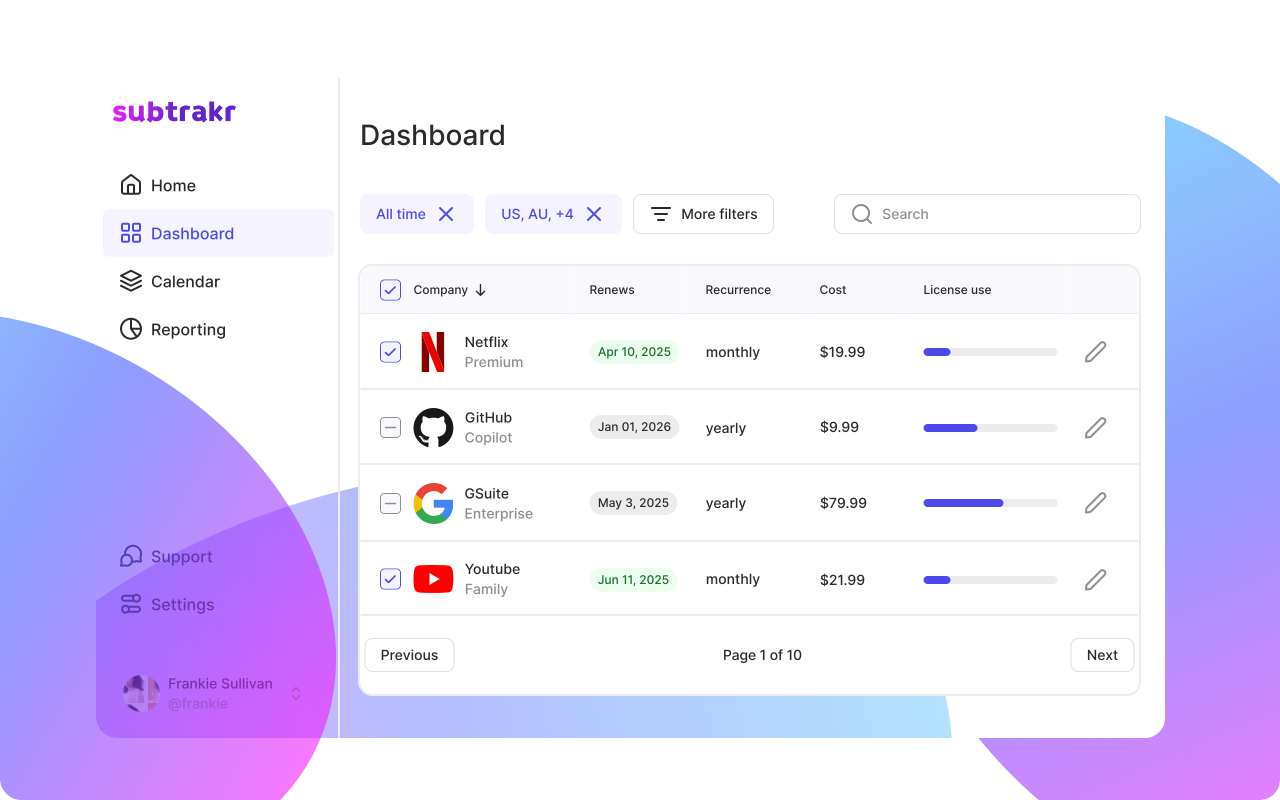
If you want a structured place to track renewal dates and notice deadlines across your entire SaaS stack, Subtrakr lets you log each recurring expense with its renewal date so nothing slips through.