Quick answer
A no-blame spend review meeting is a structured 30 to 45 minute session where a team reviews recurring software spend and makes keep, cancel, downgrade, or renegotiate decisions on each line item, without assigning fault for how the spend accumulated. The format works because it separates two questions that usually get mixed together: who approved this, and does this still make sense. The meeting only answers the second one. That single rule is what makes people show up willing to talk instead of showing up ready to defend a decision from eight months ago.
Most spend review meetings quietly turn into interrogations. Someone asks why a tool nobody remembers approving is still costing $400 a month, the room goes tense, and the meeting ends with an action item to "look into it" that never gets looked into. Nothing gets cancelled, nothing gets renegotiated, and the same tools show up on next quarter's list.
Stay Updated with Subtrakr
Sign up to our newsletter to get updates about Subtrakr and valuable insights about subscriptions and recurring expense management.
This matters because subscription sprawl is rarely caused by one bad decision. It is caused by dozens of reasonable decisions made at different times by different people, none of whom had visibility into what everyone else was approving. Blaming an individual for that pattern does not fix the pattern. A recurring review does.
Why Do Spend Reviews Usually Fail?
They fail because they are framed as audits of people rather than audits of tools. When a meeting opens with "who signed off on this," attendees switch into defense mode, and defense mode is the opposite of the state you need for fast decisions.
The common failure modes:
- The meeting becomes a scavenger hunt. Nobody prepared data in advance, so the first 20 minutes are spent pulling up invoices live.
- One tool eats the whole meeting. A single contentious line item turns into a 25-minute debate while ten other tools go unreviewed.
- Decisions get deferred, not made. "Let's revisit this next quarter" is where subscription spend goes to survive indefinitely.
- Ownership is unclear. Nobody leaves the meeting knowing who is responsible for actually cancelling or renegotiating anything. Assign names first with a spend ownership matrix so every decision already has an owner.
A no-blame format fixes all four by changing what the meeting is structured to produce: not explanations, but decisions.
What Should You Prepare Before the Meeting?
Bring the numbers, not the opinions. A useful spend review meeting is preceded by a short prep step, not a live discovery process.
Before the meeting, one person (rotate this role) pulls together:
- A current list of active recurring tools with monthly cost and billing cycle
- Last known usage signal for each, even something rough like "3 active users" or "no login in 60 days"
- Renewal date for each tool, so upcoming decisions get priority
- Any tools flagged by someone as "not sure why we still have this"
If your team already runs a recurring expense audit, this prep step is largely already done. The spend review meeting is where that audit data turns into decisions, not where the audit itself happens.
What Is the Meeting Structure?
Step-by-Step Meeting Format (Time required: 30 to 45 minutes)
- Set the frame (2 minutes). Open by stating the rule explicitly: this meeting reviews tools, not people. No one needs to explain why a decision was made a year ago. The only question is whether it still holds up today.
- Walk the list top to bottom by cost (20 to 30 minutes). Start with the highest-cost items, since that is where the biggest decisions live. For each line item, spend no more than 2 to 3 minutes. Ask one question: keep, cancel, downgrade, or renegotiate.
- Assign an owner and a date to every decision (5 minutes). A decision without an owner does not happen. Every "cancel" or "renegotiate" gets a name and a deadline attached before the meeting ends.
- Close with a total (2 minutes). State the projected monthly savings out loud. This turns an abstract exercise into a visible result and makes the next meeting easier to justify.
Cap discussion time per item strictly. If a tool needs more than 3 minutes of debate, it becomes an action item for someone to investigate offline, not a topic the whole meeting gets pulled into.
How Do You Handle a Tool Nobody Remembers Approving?
Treat it as a data gap, not a mistake. Say something like "we don't have clear usage data on this one" and assign someone to check actual usage before the next meeting, rather than asking who approved it.
This reframes an awkward moment into a normal action item. In practice, most forgotten tools fall into one of two categories: genuinely unused and safe to cancel, or quietly essential to one team that nobody else talks to. A short usage check resolves both without anyone needing to defend a past decision.
What Decision Categories Should You Use?
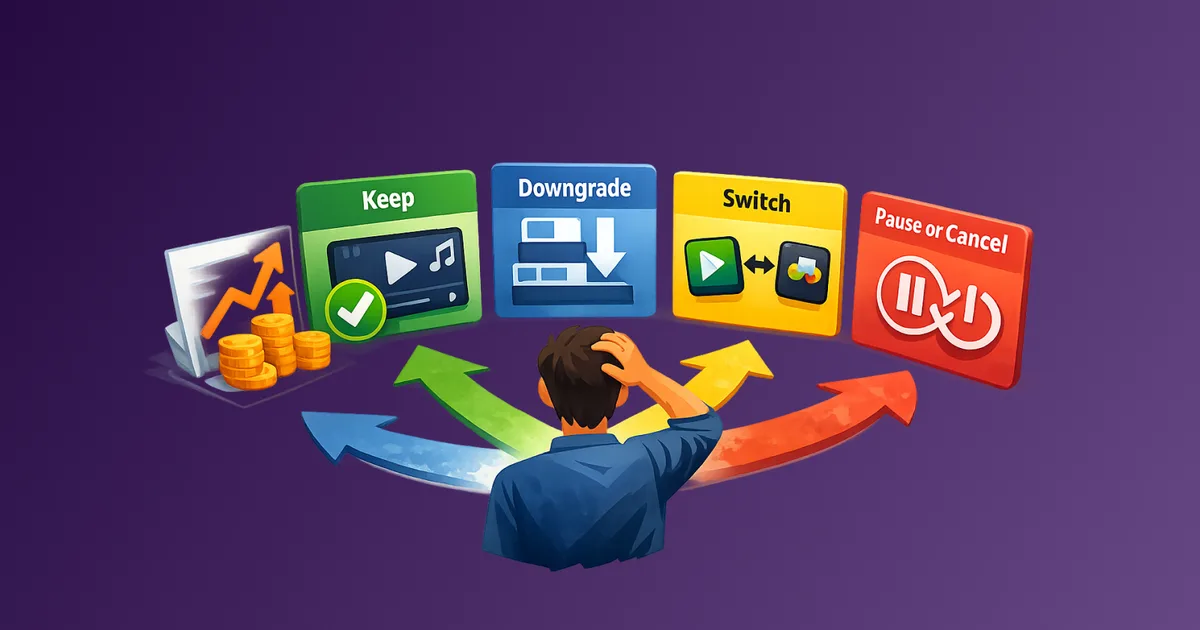
Keep the options few and consistent so the meeting moves fast. Four categories cover nearly every case:
| Decision | When to use it |
|---|---|
| Keep | Clear active use, cost is reasonable for the value delivered |
| Cancel | No active use, or a free/cheaper alternative already covers the need |
| Downgrade | Tool is used, but on a tier with unused features or seats |
| Renegotiate | Tool is valuable but priced above market, or renewal is approaching |
Avoid adding a fifth "revisit later" category. It becomes a default escape hatch, and tools parked there tend to stay parked there for years.
Copy-Paste Meeting Agenda
NO-BLAME SPEND REVIEW — [Month/Quarter]
Attendees: [names]
Prep owner: [name]

1. Frame (2 min): We review tools, not people. Decisions only.
2. Line-item review, highest cost first (2-3 min per item):
   - Tool name / Monthly cost / Last known usage / Renewal date
   - Decision: Keep / Cancel / Downgrade / Renegotiate
   - Owner + deadline
3. Unclear items → assign a usage check, not a debate
4. Total projected monthly savings: $____
5. Next review date: ____
Common Mistakes
- Reviewing every tool with the same depth. A $12/month tool does not need the same scrutiny as a $1,200/month one. Sort by cost and let time allocation follow.
- Letting the meeting become open-ended. Without a hard time cap per item, one disagreement can consume the whole session.
- Skipping the owner assignment. A list of "we should cancel this" without a named owner and date is a list of things that will still be active next quarter.
- Framing questions around people instead of tools. "Why do we have this" invites a defensive answer. "Is this still worth the cost" invites a useful one.
- Not tracking the outcome. If nobody records what was decided, the same debate repeats at the next review. A running subscription tracker or tagging system keeps decisions visible between meetings.
FAQ
How often should a no-blame spend review happen?
Monthly for fast-growing teams with frequent tool sign-ups, quarterly for stable teams. Renewal-heavy months are a good trigger for an ad hoc review.
Who should attend?
Whoever has visibility into how tools are actually used, typically a mix of finance and the department heads whose teams use the tools being reviewed. Keep the group small enough to move fast.
What if a tool's usage data is missing?
Assign a short usage check as an action item rather than debating it live. Revisit it at the next meeting with actual data.
Does this replace a formal procurement approval process?
No. This is a recurring review of spend that already exists, not a gate for new purchases. It works alongside an approval process, not in place of one.
What if someone gets defensive anyway?
Restate the frame calmly: the meeting evaluates tools, not the people who chose them. Redirecting to the decision categories usually resolves it faster than discussing intent.
How is this different from a regular budget review?
A budget review typically looks at totals and trends. A spend review goes line by line and ends every item with a specific keep, cancel, downgrade, or renegotiate decision.
Next Action
Schedule the first no-blame spend review for this month. Pull last quarter's tool list, sort it by cost, and cap the meeting at 45 minutes. The goal is not a perfect audit. It is a short list of decisions with owners and dates attached. Escalate only the items that need authority, a freeze, or a budget exception onto a board-ready recurring spend report.