Quick answer
Approval delays inflate the real cost of any tool by extending the time-to-value gap, compressing the useful billing period, and creating workaround spend that often goes untracked. A lean approval flow with a defined process, clear thresholds, and a central record of active tools eliminates most of this friction without adding bureaucracy.
Every tool request that sits in someone's inbox for two weeks has a price. Not on the invoice. Not in the contract. But it is there, quietly running in the background while the work that tool was supposed to unblock stays stalled.
Stay Updated with Subtrakr
Sign up to our newsletter to get updates about Subtrakr and valuable insights about subscriptions and recurring expense management.
Approval delays are one of the most overlooked sources of recurring cost inflation in small teams and growing businesses. The subscription gets added to the books eventually, but the cost of the wait rarely gets counted.
Why Does Tool Procurement Take So Long?
Most approval delays are not caused by bad intentions. They are caused by a missing structure.
In practice, a tool request goes through some combination of: a Slack message, a forwarded email, a finance form that nobody trained anyone to use, and a manager who approves things when they remember to. There is no defined ownership, no standard timeline, and no clear criteria for a yes or no.
The result is a gray zone where requests age out. Some never get approved. Some get approved six weeks later and immediately charged for a full month that nobody used. Some get approved verbally but never officially recorded, which means the subscription lives outside any tracking system from day one.
What Is the Actual Cost of a Delayed Approval?
The cost shows up in three places that most teams do not measure together.
Lost productivity during the wait. If a developer, marketer, or analyst needs a specific tool to complete a task, the delay does not freeze time. Work continues, but at reduced output. That gap has a real cost per day even if it is invisible in your budget.
Wasted billing cycles. Monthly subscriptions start billing on day one of activation. If a tool gets approved in week three and the team starts using it properly in week five, the first billing cycle is largely wasted. For annual plans, the math gets worse: approval delays can push activation past the point where annual billing makes sense, so teams default to monthly pricing and pay more per seat over time.
Untracked workaround spend. While waiting for the approved tool, teams find workarounds. Free trials that auto-convert. Personal cards used to unblock the project. A different tool purchased under a different budget line. These entries rarely get consolidated. They accumulate as shadow spend that does not show up in any recurring expense review until an audit surfaces them.
A recurring expense audit often reveals a cluster of tools that were purchased as workarounds and never retired after the original request finally got approved.
How Do Approval Delays Compound Over Time?
A single delayed approval is a minor friction event. But at organizational scale, or across a full year of tool procurement, the compounding effect is significant.
Consider a team that processes ten tool requests per quarter. If four of them take more than three weeks to approve, and each wasted billing cycle costs roughly one month of subscription fees, the team is effectively paying for a tool they are not using every quarter. Add shadow spend from workarounds and the number climbs further.
There is also a secondary effect: when approvals are slow, people stop requesting tools through the official channel. They either absorb the friction by not using the tool at all, or they bypass the process entirely. Both outcomes are worse than a fast approval flow. The first limits productivity. The second creates untracked recurring spend, often shadow AI on a personal card, that compounds quietly until someone finds tools nobody officially authorized.
What Is a Lean Approval Flow and How Does It Work?
A lean approval flow is a defined process that reduces decision latency without adding bureaucratic weight. It is not a committee. It is a clear set of rules that most requests can pass through in 48 hours or less.
The core structure has four components.
1. A spend threshold for auto-approval. Define a monthly cost below which a tool can be activated without manager review. A common threshold for small teams is $30 to $50 per month per seat. Anything below that threshold gets logged and activated. Anything above goes to a single decision-maker, not a chain.
2. A single approval owner per budget area. Tool requests routed to a team or a distribution list die in committees. One person owns the decision for each category of spend. That person has a 48-hour response commitment. If they miss the window, the request escalates automatically.
3. A standard request format. The person requesting the tool provides four things: what the tool does, what problem it solves, how much it costs per month, and whether there is an existing tool that overlaps with it. That is enough information to make a decision. Requests that do not include this do not enter the queue. For paid tools above your threshold, attach a completed subscription procurement checklist so security, SSO, seat model, exit path, and data export are answered before approval, not after activation.
4. A central log of active tools. Every approved tool gets added to a shared record with its cost, billing cycle, owner, and renewal date. This is the operational core of the whole system. Without it, approvals create orphaned subscriptions that nobody tracks. Assign that owner with a spend ownership matrix so the log names a person, not a team.
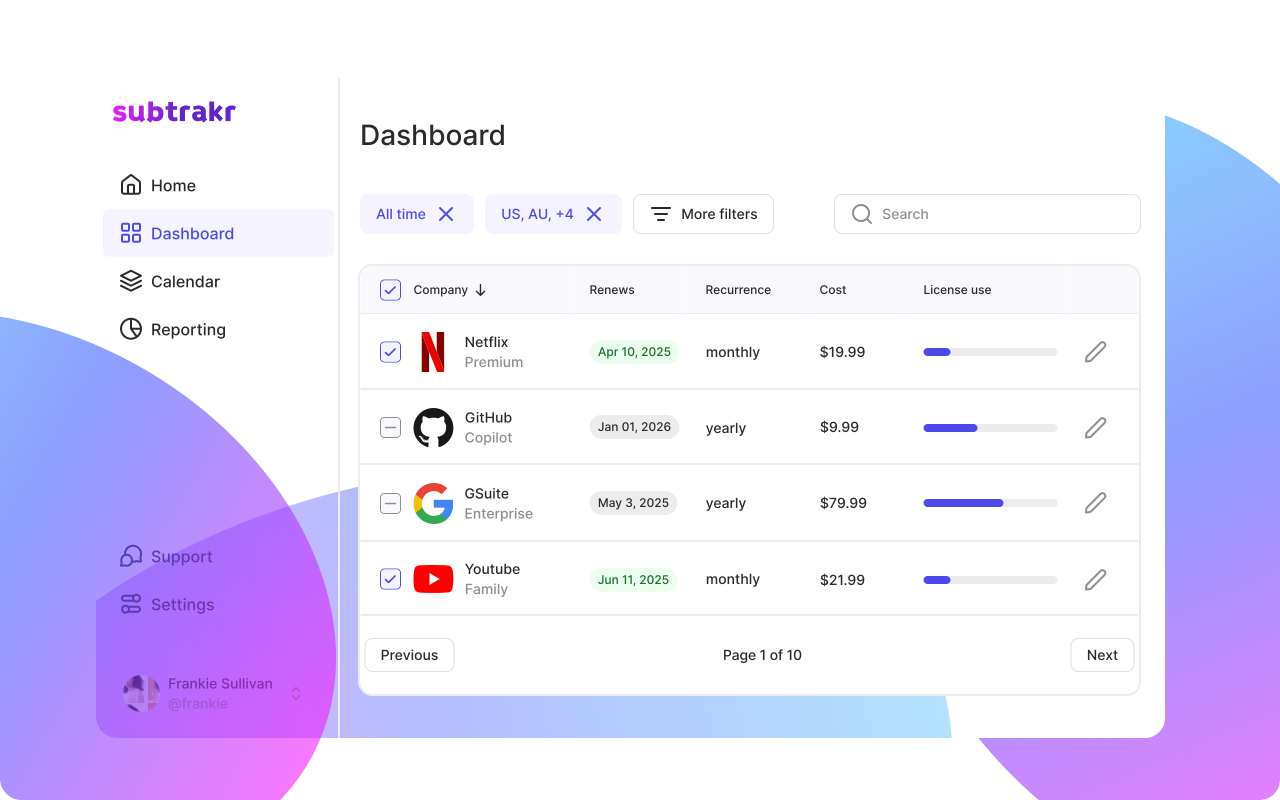
Subtrakr is built for exactly this last step. Once a tool gets approved, it goes into Subtrakr with its monthly equivalent cost, renewal date, and assigned owner. That entry makes it visible in every future review, prevents surprise renewals, and creates a baseline for cancellation decisions when usage drops.
Which Tools Are Most Likely to Get Stuck in Approval Delays?
Not all tool categories behave the same way in procurement. Some are more likely to trigger long review cycles.
AI and automation tools tend to get flagged for security review, which adds a parallel track to the approval process. If your organization does not have a defined security review process for SaaS tools, this becomes a second bottleneck on top of the first.
Tools with per-seat pricing require headcount input from multiple parties: the requester, the manager, and sometimes HR or finance. Each additional party adds latency.
Annual-billed tools get more scrutiny because the commitment is higher. This is rational, but if the approval process takes three weeks and the annual plan requires a decision, the window for getting the best price may close before approval arrives.
Redundant-category tools get delayed because someone needs to verify whether a similar tool already exists in the stack. Without a central tool registry, that verification takes manual effort and often stalls entirely.
The lean approval flow addresses all of these by requiring the requester to answer the overlap question upfront, and by giving the approver access to the current tool registry before making a decision.
Step-by-Step: Set Up a Lean Approval Flow (Time required: 2–3 hours)
Step 1: Define your auto-approval threshold.
Choose a monthly cost ceiling below which tools can be activated with just a log entry. Start conservative ($25 to $40 per month) and adjust after 90 days.
Step 2: Assign one approval owner per budget area.
Engineering tools, marketing tools, operations tools. One person per category. Document the owner publicly so requesters know exactly where to send requests.
Step 3: Create a standard request template.
Four fields: tool name, use case, monthly cost, and overlap check. Make this the only accepted format. Requests submitted outside this format get sent back.
Step 4: Set a 48-hour SLA.
The approval owner commits to responding within 48 business hours. No response triggers an automatic escalation to their manager or a defined backup.
Step 5: Build your tool registry.
Start with a list of every currently active subscription, its monthly cost, its renewal date, and its owner. Add every newly approved tool to this list immediately after approval. This list becomes the foundation for every future procurement and cancellation decision.
Step 6: Run a quarterly review.
Every 90 days, review the tool registry against actual usage. Tools with low usage relative to cost enter a cancellation evaluation. Tools with billing cycles ending within 60 days get renewal decisions made in advance, not under deadline pressure.
Copy-Paste: Tool Procurement Request Template
Tool Name:
Vendor / URL:
Monthly cost per seat:
Number of seats requested:
Total monthly cost:
Billing cycle (monthly / annual):
Use case (2–3 sentences):
Does an existing tool in our stack overlap with this? (Yes / No / Unsure)
If yes, which tool and why is the new one needed?
Requested start date:
Common Mistakes That Make Approval Delays Worse
Routing requests to a group instead of a person. Group ownership means no one owns the deadline. Define a single decision-maker for each category.
No overlap check at request time. If the requester does not check for redundancy, the approver has to. That investigation takes time and often stalls the process. Require the overlap check upfront.
Approving tools without logging them. Verbal approvals and email threads do not create a record. Every approved tool needs a registry entry with cost, cycle, and owner before it is activated.
Using monthly billing by default while waiting for annual approval. If the annual plan is the target and approval takes longer than expected, teams sometimes start on monthly and forget to switch. That difference accumulates. Track billing cycles as part of the registry.
Letting trials run during the approval process. If a free trial converts to paid before the approval completes, the tool is now active and billing without official authorization. Set trial end dates as hard deadlines in the approval queue.
FAQ
What is the right approval threshold for a small team?
For teams of 5 to 20 people, a common starting point is $30 to $50 per month per tool. Annual commitments above $300 to $500 typically warrant a review regardless of monthly equivalent.
How long should a tool approval take?
A lean flow should resolve most requests in 24 to 48 business hours. Anything longer is a process problem, not a complexity problem.
What happens to tools approved without a central log?
They become invisible recurring costs. They survive budget reviews because no one knows they exist. They get discovered eventually in a subscription audit, usually after months of unmonitored spend.
Should every tool go through the same approval process?
No. Threshold-based routing is the point. Low-cost tools should auto-approve with a log entry. High-cost or high-commitment tools get a single reviewer. Enterprise tools with security implications get a parallel security review track.
Can the approval process itself create shadow spend?
Yes. When approval cycles are too slow, people work around them. That workaround spend often stays off the books permanently because no one wants to surface how the official process failed.
How does Subtrakr fit into this workflow?
Subtrakr serves as the tool registry and renewal calendar. Every approved tool gets entered manually with its cost, cycle, and owner. Subtrakr then tracks monthly equivalents, flags upcoming renewals, and provides a running total that makes budget reviews factual rather than estimated.
Next Action
Map your current tool approval process in writing. If it takes more than three sentences to describe, it is too complex. Identify the single biggest delay point and assign an owner to it this week.
If you do not have a central tool registry yet, start one now. A list of active tools with costs and renewal dates is the minimum viable system. Build from there.